
When your jaw hurts when you chew, even a normal meal can become uncomfortable. The pain may feel like a dull ache, sharp twinge, pressure, or soreness around one side of your face.
The source isn’t always the jaw itself.
Problems involving the teeth, gums, chewing muscles, or temporomandibular joints can all cause pain during chewing. In some cases, something as simple as frequent gum chewing or nighttime teeth grinding can leave the jaw muscles sore. Other times, the problem may involve a cavity, cracked tooth, gum disease, or dental infection.
Pain around the ear, jaw stiffness, clicking, or difficulty opening your mouth can occur with temporomandibular disorders (TMD). TMD describes a group of conditions affecting the jaw joints and the muscles responsible for chewing.
The pattern of your symptoms can offer clues, but it cannot replace a professional examination.
If the pain keeps returning, interferes with eating, or appears with swelling, fever, or severe tooth pain, it’s time to get it checked.
Why Does My Jaw Hurt When I Chew?
Chewing is more complicated than it looks.
Your jaw muscles contract, your lower jaw moves, and the temporomandibular joints work together to help you bite and grind food. Your teeth and gums also absorb pressure with every bite.
Pain can develop when one or more of these structures becomes irritated, inflamed, injured, or infected.
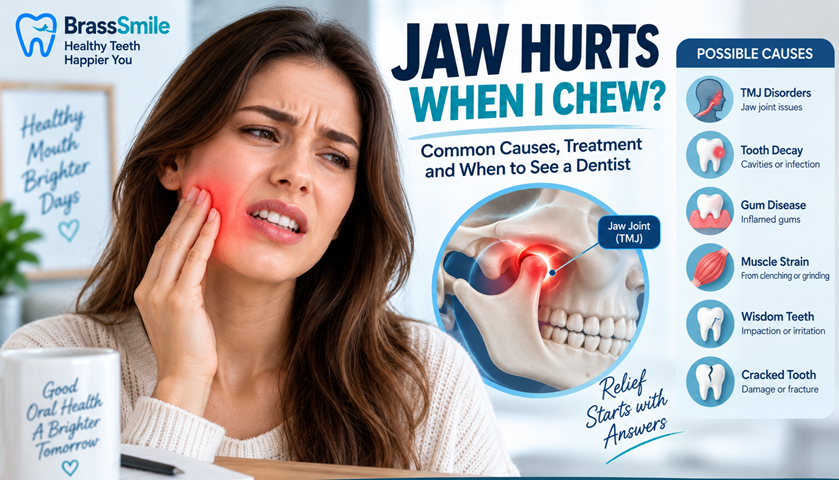
Common causes include:
- Temporomandibular disorders (TMD)
- Teeth grinding or jaw clenching
- Overworked or strained jaw muscles
- Cavities and tooth decay
- Dental infections
- Gum disease
- Cracked or damaged teeth
- Wisdom tooth problems
- Recent dental treatment
- Jaw injuries
- Arthritis and other joint conditions
One important point often gets overlooked: jaw pain doesn’t always mean you have a jaw-joint problem.
A painful tooth can radiate into the surrounding jaw and make it feel as though the entire side of your face hurts. That’s why persistent or unexplained pain deserves a proper evaluation.
Also Reed: How to Keep Gums Healthy
Common Causes of Jaw Pain When Chewing: Jaw Hurts When I Chew
1. Temporomandibular Disorders (TMD)
TMD is one of the most common reasons people experience pain involving the jaw joint or chewing muscles.
The term covers a wide range of conditions rather than one specific disease. NIDCR identifies numerous disorders involving the jaw joints, chewing muscles, and related structures.
Possible symptoms include:
- Jaw pain while chewing
- Tender chewing muscles
- Pain near the ear
- Jaw stiffness
- Reduced ability to open the mouth
- Painful clicking or popping
- Jaw locking
- Facial pain
- Headaches associated with jaw discomfort
A clicking or popping sound doesn’t automatically mean you have TMD. Many people experience jaw noises without pain or other symptoms, and those sounds alone usually don’t require treatment.
What causes TMD?
There isn’t always one obvious cause.
An injury can trigger some cases. Researchers also recognize that factors such as genetics, stress, pain sensitivity, and other physical or behavioral factors may play a role.
It’s also worth clearing up an old misconception. Current evidence doesn’t support the idea that a person’s bite or orthodontic treatment automatically causes TMD.
Because several conditions can produce similar symptoms, diagnosis requires more than simply hearing a click in your jaw.
2. Teeth Grinding and Jaw Clenching
You may be putting more pressure on your jaw than you realize.
Some people clench their teeth during stressful moments. Others grind or clench while sleeping and don’t know they’re doing it until a dentist notices signs of wear.
Repeated pressure can fatigue the chewing muscles and contribute to jaw soreness. It can also damage teeth over time.
You may notice:
- Jaw soreness after waking up
- Tenderness around the cheeks or temples
- Frequent headaches
- Chipped or worn teeth
- Facial muscle fatigue
- Pain that becomes worse after chewing
If you suspect nighttime grinding, talk with your dentist. A dental professional can determine whether a protective appliance or another approach makes sense for you.
3. Tooth Decay or a Dental Infection
Sometimes the problem begins with a tooth, not the jaw.
A cavity can cause discomfort when you bite or chew. As decay progresses, it can reach deeper parts of the tooth and cause significant pain.
An untreated infection may eventually form a dental abscess. That can produce severe tooth pain, swelling, fever, or a bad taste in the mouth. NIDCR explains that untreated tooth decay can progress and cause pain and infection.
Watch for signs such as:
- Severe toothache
- Pain when biting down
- Hot or cold sensitivity
- Swollen gums
- Jaw or facial swelling
- Fever
- Bad taste or drainage
A dental abscess requires professional treatment. It should not be expected to disappear on its own.
4. Gum Disease
Healthy gums should not routinely hurt when you eat.
Gum disease can cause inflammation, tenderness, bleeding, and swelling. As periodontal disease progresses, it can damage the tissues and bone supporting your teeth.
NIDCR lists pain while chewing among the possible symptoms of periodontal disease. Other warning signs include bleeding gums, gum recession, loose teeth, sensitive teeth, and persistent bad breath.
If your jaw hurts when you chew and your gums bleed regularly, don’t assume the pain comes from your TMJ.
A dental examination can help determine whether gum disease, a tooth problem, or another condition is responsible.
5. A Cracked or Damaged Tooth
A cracked tooth can produce a surprisingly specific kind of pain.
You may feel a sharp sensation when biting into food. In some cases, the pain appears when you release your bite rather than when you first bite down.
Other clues include:
- Pain around one particular tooth
- Sensitivity to hot or cold foods
- Pain that comes and goes
- A chipped tooth
- Discomfort when chewing harder foods
Cracks aren’t always visible in a mirror. Your dentist may need to perform a careful examination to determine what’s happening.
6. Wisdom Tooth Problems
Wisdom teeth can cause jaw discomfort when they erupt, become impacted, or develop inflammation around the surrounding gum tissue.
You may also experience:
- Pain at the back of the mouth
- Swollen gums
- Bad breath
- Tenderness
- Difficulty opening your mouth
- Pain while chewing
Because wisdom tooth symptoms can resemble other dental problems, don’t assume the wisdom tooth is responsible without an examination.
7. Recent Dental Treatment
A long dental appointment can temporarily leave your jaw feeling sore.
Keeping your mouth open for an extended period can fatigue the chewing muscles. Mild soreness may settle as the muscles recover.
However, worsening pain isn’t something to simply ignore.
Contact your dentist if you develop significant swelling, fever, severe tooth pain, or other symptoms after dental treatment.
Jaw Pain vs. Tooth Pain: How Can You Tell?: Jaw Hurts When I Chew
Jaw and tooth pain can overlap, which makes self-diagnosis difficult.
Still, certain patterns can provide useful clues.
| Symptom pattern | Possible source |
|---|---|
| Pain directly around the jaw joint | TMD or another joint problem |
| Soreness across the chewing muscles | Muscle strain or TMD |
| Sharp pain from one tooth | Cavity, crack, or tooth damage |
| Pain from hot or cold foods | Tooth sensitivity or decay |
| Red or bleeding gums | Gum disease |
| Jaw swelling with fever | Dental infection |
| Pain after clenching | Muscle strain or TMD |
| Clicking with painful movement | Possible TMD |
| Difficulty opening the mouth | TMD, infection, or injury |
| Pain after an accident | Jaw or facial injury |
These are general patterns, not diagnostic rules. Several conditions can produce similar symptoms.
What Can You Do If Your Jaw Hurts When You Chew?: Jaw Hurts When I Chew
If the pain is mild and you don’t have concerning symptoms, a few conservative measures may reduce irritation.
Choose Softer Foods
Give your jaw less work for a few days.
Consider foods such as:
- Yogurt
- Oatmeal
- Scrambled eggs
- Soup
- Mashed potatoes
- Soft-cooked vegetables
- Tender fish
You don’t need to change your diet permanently. The goal is to temporarily reduce the amount of force required for chewing.
Give Your Jaw a Break
Avoid activities that keep your jaw working unnecessarily.
That includes:
- Chewing gum
- Chewing ice
- Biting your nails
- Eating extremely tough foods
- Biting pens or other objects
For some TMD-related symptoms, NIDCR recommends conservative measures such as eating softer foods and reducing habits that strain the jaw.
Try Heat or Cold
A warm or cold compress may provide temporary relief for some types of jaw discomfort.
Use whichever feels more comfortable. Avoid placing extreme temperatures directly against your skin.
Watch for Clenching
Pay attention to what your jaw does when you’re working, driving, exercising, or feeling stressed.
If you notice your teeth pressed tightly together, consciously relax your jaw.
Consider OTC Pain Relief
Some adults can safely use an over-the-counter pain reliever for short-term discomfort.
Follow the product’s directions. If you take other medications, have a medical condition, are pregnant, or aren’t sure which medicine is appropriate, ask a healthcare professional or pharmacist first.
Pain medication can reduce discomfort, but it won’t fix an infected tooth, cracked tooth, or other underlying problem.
What Should You Avoid?: Jaw Hurts When I Chew
When your jaw hurts, some common reactions can actually make things worse.
Don’t force your jaw open
Avoid aggressive stretching or manipulating a painful jaw without professional guidance.
Don’t keep chewing through severe pain
Pain is a reason to reduce the workload on the area, not a challenge to push through.
Don’t assume it’s automatically TMJ
A painful jaw can come from a tooth, gum infection, wisdom tooth, muscle strain, or several other causes.
Don’t rush into irreversible treatment
For TMD, conservative approaches are generally preferred before treatments that permanently change the teeth, bite, or jaw joint. NIDCR specifically recommends caution with irreversible treatments for TMD.
When Should You See a Dentist?
Make a dental appointment if your jaw pain:
- Lasts more than a few days
- Keeps coming back
- Gets worse over time
- Makes eating difficult
- Occurs with tooth pain
- Comes with bleeding or swollen gums
- Causes significant sensitivity
- Limits your ability to open your mouth
- Appears after dental treatment
- Develops following an injury
You don’t have to wait until the pain becomes severe.
A dentist can examine your teeth, gums, jaw movement, chewing muscles, and joints. Depending on the symptoms, dental X-rays or other imaging may help identify the cause.
TMD can be particularly difficult to diagnose because several different conditions can create similar symptoms.
When Is Jaw Pain an Emergency?: Jaw Hurts When I Chew
Most jaw pain isn’t an emergency. Some symptoms, however, require immediate attention.
Seek urgent dental or medical care if you experience:
- Significant facial or jaw swelling
- Fever with severe dental pain
- Rapidly worsening swelling
- Severe difficulty opening your mouth
- A serious facial injury
Get emergency medical help if swelling makes it difficult to:
- Breathe
- Swallow
- Speak
A serious dental infection can spread into surrounding tissues and potentially threaten the airway.
Don’t wait for a routine appointment if you’re having trouble breathing or swallowing.
How Does a Dentist Find the Cause?
Your appointment will usually begin with a conversation about the pain.
Your dentist may ask:
- Where exactly does it hurt?
- When did the pain begin?
- Does chewing make it worse?
- Does one tooth hurt?
- Is the pain sharp, dull, or throbbing?
- Do you grind or clench your teeth?
- Does your jaw click or lock?
- Have you recently had dental work?
- Did you injure your face or jaw?
- Do you have swelling, fever, or drainage?
The dentist can then examine your teeth, gums, jaw movement, and chewing muscles.
Imaging may be appropriate depending on the suspected cause. NIDCR notes that dental X-rays, MRI, or CT imaging may sometimes help evaluate jaw-joint or other structural problems.
The goal isn’t simply to identify where it hurts. It’s to determine why it hurts.
TMD vs. Dental Problems
| Feature | TMD | Tooth or gum problem |
|---|---|---|
| Pain near the ear | Common | Sometimes |
| Jaw-joint discomfort | Common | Less typical |
| Chewing-muscle soreness | Common | Less typical |
| Pain from one tooth | Less typical | Common |
| Bleeding gums | Not typical | Common with gum disease |
| Fever | Not typical | Possible with infection |
| Facial swelling | Less typical | Possible with infection |
| Tooth sensitivity | Less typical | Common |
| Clicking or popping | Can occur | Usually unrelated |
| Pain when chewing | Common | Common |
| Limited jaw movement | Can occur | Can occur with severe infection |
The overlap explains why a professional evaluation can be more useful than trying to identify the cause from symptoms alone.
Pros and Cons of Home Care for Mild Jaw Pain
| Approach | Potential benefit | Limitation |
|---|---|---|
| Soft foods | Reduces chewing pressure | Doesn’t treat the underlying cause |
| Heat or cold | May temporarily ease discomfort | Relief may not last |
| Avoiding gum | Reduces repetitive jaw movement | Doesn’t resolve dental disease |
| Relaxing the jaw | May reduce muscle tension | Requires awareness and consistency |
| OTC pain relief | Can reduce short-term pain | Doesn’t diagnose or cure the cause |
The main advantage of conservative care is simple: it can reduce stress on an irritated area.
The limitation is equally important. Feeling better doesn’t necessarily mean the underlying problem has gone away.
Expert Tips for Protecting Your Jaw and Teeth
Don’t chew gum constantly
Gum isn’t automatically harmful, but hours of repetitive chewing can place unnecessary stress on the jaw.
Pay attention to clenching
If your jaw feels tired or sore at the end of the day, notice whether you’re frequently tightening your teeth.
Protect your teeth from unnecessary pressure
Don’t chew ice, pens, fingernails, or other hard objects. These habits can damage teeth and create another source of pain.
Maintain good oral hygiene
Brush twice a day with fluoride toothpaste and clean between your teeth daily.
Consistent oral care helps reduce plaque and lowers the risk of cavities and gum disease.
Take recurring pain seriously
Pain that repeatedly disappears and returns still deserves attention.
A recurring pattern may provide your dentist with an important clue about what’s causing the problem.
(FAQs) About Jaw Hurts When I Chew
1. Why does my jaw hurt when I chew?
Your jaw may hurt when chewing because of TMD, muscle strain, teeth grinding, a cavity, gum disease, a dental infection, a cracked tooth, or wisdom tooth problems.
2. Is jaw pain when chewing a sign of TMJ?
It can be. TMD may cause jaw-joint or chewing-muscle pain, stiffness, painful clicking, or limited movement. However, dental problems can cause similar symptoms.
3. Why does my jaw hurt on one side when I chew?
One-sided pain may come from a specific tooth, gum problem, jaw joint, chewing muscle, wisdom tooth, or localized inflammation. A dental examination can help identify the source.
4. Can a cavity make my jaw hurt?
Yes. Tooth decay can cause significant pain as it progresses. If the tooth becomes infected, you may also develop swelling or pain that spreads into the jaw.
5. Can gum disease cause jaw pain?
It can. More advanced periodontal disease may cause painful chewing, loose teeth, gum recession, and tooth sensitivity.
6. Should I eat normally if my jaw hurts?
If chewing increases the pain, softer foods may reduce strain temporarily. If the problem persists, schedule a dental evaluation rather than relying on dietary changes alone.
7. How long should jaw pain last?
The duration depends on the cause. Temporary muscle soreness may improve with rest, while infections, damaged teeth, and some jaw disorders may require professional treatment.
8. When should I see a dentist for jaw pain?
See a dentist if the pain persists, keeps returning, affects eating, or occurs alongside tooth pain, swelling, bleeding gums, fever, or restricted jaw movement.
9. Can stress cause jaw pain?
Stress can contribute to clenching or grinding, which may overload the chewing muscles. Still, persistent pain should not automatically be blamed on stress.
10. Can jaw pain be an emergency?
Yes, in certain situations. Severe swelling that affects breathing or swallowing requires emergency medical attention. Significant facial trauma also warrants prompt evaluation.
Final Thoughts: Jaw Hurts When I Chew
When your jaw hurts when you chew, the temptation is to assume you’ve simply strained a muscle or developed TMJ pain.
Sometimes that’s true. But the same symptom can come from a cavity, cracked tooth, gum disease, wisdom tooth, dental infection, or another condition.
The pattern matters.
Pain around the jaw joint with stiffness or painful clicking may suggest TMD. Pain centered around one tooth may point toward a dental problem. Swelling and fever raise a different level of concern.
If the discomfort is mild and improving, temporarily eating softer foods, avoiding excessive chewing, and giving your jaw a break may help.
If the pain persists, returns frequently, or affects your ability to eat, arrange a dental evaluation. And if you develop severe swelling or difficulty breathing or swallowing, seek emergency care.
You shouldn’t have to work around jaw pain every time you eat. Finding the cause is the first step toward getting back to comfortable, everyday chewing.