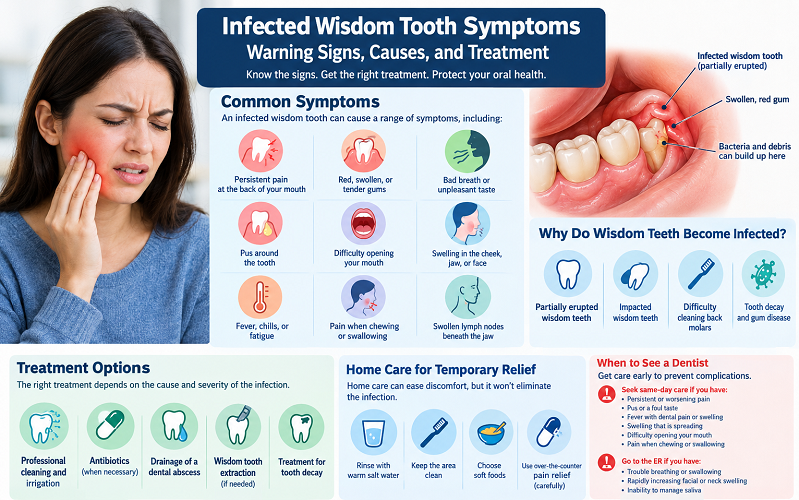

Pain at the back of your mouth can start as a minor annoyance. A little gum tenderness or discomfort while chewing may not seem serious. But when the pain persists or swelling develops, an infected wisdom tooth could be the reason. Recognising infected wisdom tooth symptoms early can help you get the right treatment before the problem worsens. Some infections remain confined to the gums, while others can spread into nearby tissues and require urgent care.
Wisdom teeth are the last permanent molars to emerge. They typically appear between ages 17 and 25, although some erupt later and others never emerge. Because these teeth sit so far back in the mouth, keeping them clean can be difficult. Problems become more likely when a tooth grows at an angle or remains partially trapped beneath the gums.
Bacteria can collect around the tooth, irritating the surrounding tissue and sometimes causing an infection. Common warning signs include swollen gums, persistent pain, bad breath, an unpleasant taste, and difficulty opening your mouth.
Here’s how to recognise the warning signs, understand the possible causes, and know when to see a dentist.
Also Read: Jaw Hurts When I Chew
What Are the Most Common Infected Wisdom Tooth Symptoms?
Symptoms vary depending on the location and severity of the infection. You may experience just one warning sign or several at the same time.
1. Persistent Pain at the Back of Your Mouth
Pain near the last molar is often the first sign that something isn’t right. It may begin as mild soreness before developing into a persistent ache or sharp pain.
The discomfort can worsen when you chew, bite down, or touch the surrounding gums. Sometimes, the pain spreads toward the ear, temple, or jaw.
Don’t automatically assume that the tooth is simply coming in. Normal eruption can cause temporary tenderness, but persistent or worsening pain deserves a dental examination.
2. Red, Swollen, or Tender Gums
Healthy gums should not remain noticeably swollen or painful around an erupting tooth.
When a wisdom tooth emerges only partially, a flap of gum tissue may cover part of its surface. Food particles and bacteria can collect underneath, making the area difficult to clean.
This can lead to pericoronitis, an inflammation or infection of the tissue surrounding a partially erupted tooth. The gums may look red, feel tender, or swell enough to make chewing uncomfortable.
A dentist can determine whether professional cleaning, medication, or additional treatment is necessary.
3. Persistent Bad Breath or an Unpleasant Taste
An infected wisdom tooth can leave a foul taste in your mouth, even after brushing. Bacteria and trapped food may produce an unpleasant odour, particularly when the affected area is difficult to clean.
Some people notice the taste most strongly in the morning or after eating. Others experience bad breath that returns shortly after brushing or rinsing.
Bad breath alone doesn’t confirm an infection. However, when it occurs alongside gum swelling, pain, or discharge, it’s worth arranging a dental appointment.
4. Pus Around the Wisdom Tooth
Pus is a significant warning sign of a possible infection or dental abscess. You may see white or yellow discharge near the affected gum or notice a sudden, unpleasant taste.
Sometimes, an abscess drains on its own. The pressure may decrease, making the tooth feel less painful for a while.
That temporary relief can be misleading. The infection may still be present, and the underlying problem needs professional treatment.
Never squeeze the swollen gum or attempt to puncture it yourself. A dentist can safely assess the area and determine whether drainage or another procedure is necessary.
5. Difficulty Opening Your Mouth
An infection can irritate the muscles and tissues around the jaw. As inflammation increases, opening your mouth may become uncomfortable or restricted.
You might struggle to yawn, brush your back teeth, or take a large bite of food. Significant restriction of jaw movement is sometimes called trismus.
This symptom deserves prompt attention, especially when it develops alongside swelling or worsening pain. Severe difficulty opening the mouth can indicate a more extensive infection.
6. Swelling in the Cheek, Jaw, or Face
A small amount of localised gum swelling may accompany inflammation around a wisdom tooth. Swelling that spreads into the cheek, jaw, or neck is more concerning.
You may notice that one side of your face looks larger than the other. The area might also feel tender, tight, or increasingly painful.
Facial swelling associated with a suspected dental infection requires urgent assessment. Rapidly increasing swelling, particularly around the neck or floor of the mouth, can threaten your airway.
Don’t wait for a routine appointment if the swelling progresses quickly.
7. Fever, Chills, or Unusual Fatigue
A fever may indicate that an infection is affecting more than the immediate gum tissue. Some people also experience chills, fatigue, or a general feeling of being unwell.
Not everyone with an infected wisdom tooth develops a fever. Its absence doesn’t rule out a serious dental problem.
Contact a dentist promptly if you develop a fever alongside wisdom tooth pain or swelling. If you also have difficulty swallowing, breathing problems, or rapidly spreading swelling, seek emergency medical care.
8. Pain When Chewing or Swallowing
Chewing puts pressure on the teeth and surrounding gums. When a wisdom tooth becomes infected, even ordinary meals can become uncomfortable.
You may start chewing on the opposite side or avoid certain foods altogether. In more serious cases, inflammation can make swallowing painful.
Significant difficulty swallowing is not something to manage at home. If you cannot swallow liquids or your own saliva, seek emergency care immediately.
9. Swollen Lymph Nodes Beneath the Jaw
Lymph nodes help your body respond to infection. When a dental infection develops, nearby nodes beneath the jaw or along the neck may become enlarged and tender.
You might notice small, sensitive lumps beneath your chin or near the angle of your jaw. These symptoms can occur with other infections, so they don’t establish a diagnosis on their own.
If swollen lymph nodes accompany wisdom tooth pain, gum inflammation, or fever, arrange a prompt dental examination.
Why Do Wisdom Teeth Become Infected? Infected Wisdom Tooth Symptoms
Most wisdom tooth infections develop when bacteria accumulate around the tooth or enter damaged tissue. Several conditions can make this more likely.
Partially Erupted Wisdom Teeth
A wisdom tooth doesn’t always emerge completely. Sometimes, only part of the crown breaks through the gum.
The remaining gum tissue can create a pocket where food and bacteria collect. Because the area is difficult to reach with a toothbrush, debris may remain trapped and trigger inflammation.
This is a common reason for pericoronitis, particularly when the same area becomes inflamed repeatedly.
Impacted Wisdom Teeth
An impacted wisdom tooth cannot emerge fully because of limited space, its position, or another obstruction.
Some impacted teeth cause no symptoms. Others contribute to recurring inflammation, decay, damage to neighbouring teeth, or cyst formation.
A dental examination and X-rays can help determine the tooth’s position and whether it requires treatment.
Difficulty Cleaning the Back Molars
Wisdom teeth sit at the far end of the mouth, making them harder to brush and floss effectively.
Plaque can accumulate around the tooth, while food particles may become trapped beneath the gum tissue. Even people who maintain a regular oral hygiene routine can struggle to clean a poorly positioned wisdom tooth.
Careful cleaning helps control plaque, but it cannot always prevent infection when the tooth’s position makes the area difficult to maintain.
Tooth Decay and Gum Disease
Wisdom teeth can develop cavities just like other molars. If decay progresses, bacteria may reach the inner pulp and cause deeper infection.
Gum disease can also affect the tissues supporting the tooth. Depending on the findings, treatment may involve restoring the tooth, treating the surrounding gums, or removing the tooth altogether.
Infected Wisdom Tooth vs. Normal Wisdom Tooth Eruption
Not every sore wisdom tooth is infected. Normal eruption may cause mild pressure or temporary tenderness, particularly as the tooth begins to emerge.
The pattern of symptoms can help you decide when to seek care, although only a dental examination can determine the cause.
| Symptom | Normal eruption may cause | Possible infection warning sign |
|---|---|---|
| Pain | Mild, temporary soreness | Persistent, worsening, or throbbing pain |
| Gums | Slight tenderness | Marked redness, swelling, or pus |
| Breath | Usually no noticeable change | Persistent foul odor or unpleasant taste |
| Jaw movement | Usually remains normal | Difficulty opening the mouth |
| Facial appearance | Usually unchanged | Swelling in the cheek, jaw, or neck |
| Temperature | Usually normal | Fever or chills |
| Swallowing | Usually unaffected | Painful or difficult swallowing |
These differences are general guidelines, not a diagnostic test. Other dental conditions can produce similar symptoms, and infections don’t always cause every warning sign.
When in doubt, have a dentist examine the area rather than waiting for symptoms to become severe.
How Dentists Diagnose a Wisdom Tooth Infection: Infected Wisdom Tooth Symptoms
A dentist will ask when your symptoms started, how they’ve changed, and whether you’ve experienced fever, swelling, or difficulty eating. They may also review your dental history and current medications.
During the examination, the dentist may check for:
- Redness, tenderness, and swelling around the tooth.
- Pus, trapped food, or pockets beneath the gums.
- Tooth decay or damage to nearby molars.
- Tenderness around the jaw and surrounding tissues.
- Restricted mouth opening or signs of spreading infection.
Dental X-rays can show whether a wisdom tooth is impacted, how it is positioned, and whether nearby teeth or structures may be affected.
If the infection appears extensive, the dentist may recommend additional evaluation or referral to an oral surgeon. The treatment plan depends on the source of infection, its severity, and the condition of the tooth.
How Is an Infected Wisdom Tooth Treated? Infected Wisdom Tooth Symptoms
Treatment depends on whether the problem involves the gum tissue, the tooth itself, or a deeper infection. The goal is to control the infection and address its underlying cause.
Professional Cleaning and Irrigation
For pericoronitis, a dentist may gently clean and flush the area around the partially erupted tooth.
This removes trapped food and debris while helping reduce bacterial buildup. The dentist may also show you how to keep the area clean at home.
If the same problem keeps returning, cleaning alone may not provide a lasting solution.
Antibiotics When Necessary
Antibiotics may be appropriate when an infection spreads, causes systemic symptoms, or meets other clinical criteria.
However, they aren’t automatically needed for every wisdom tooth infection. They also cannot correct an impacted tooth or replace necessary drainage and dental treatment.
Take prescribed antibiotics exactly as directed. Never use leftover medication or take antibiotics prescribed for someone else.
Drainage of a Dental Abscess
If an abscess develops, a dentist may need to drain the accumulated pus. This can relieve pressure and help control the infection.
Drainage alone may not eliminate the underlying source. The dentist must also determine whether the affected tooth or surrounding tissue needs further treatment.
Wisdom Tooth Extraction
A dentist or oral surgeon may recommend removing the wisdom tooth when infections recur, the tooth cannot be cleaned effectively, or other complications develop.
Extraction may also be appropriate when extensive decay or the tooth’s position makes it difficult to preserve.
Not every wisdom tooth needs removal. Your dentist should weigh the potential benefits and risks based on your examination, symptoms, and dental imaging.
Treatment for Tooth Decay
If decay is responsible for the infection, treatment depends on how extensively the tooth has been damaged.
A restorable tooth may benefit from a filling or another procedure. If the damage is extensive or the tooth has a poor long-term outlook, extraction may be the better option.
Your dentist can explain the available treatments and why one approach may be more suitable than another.
What Can You Do at Home for an Infected Wisdom Tooth?
Home care may ease discomfort while you arrange professional treatment. However, it cannot reliably eliminate a dental abscess or resolve every underlying infection.
Rinse With Warm Salt Water
Dissolve about half a teaspoon of salt in a glass of warm water. Gently rinse your mouth, then spit out the solution.
This may soothe irritated gums and loosen food particles. Avoid vigorous rinsing if it increases your discomfort.
Keep the Area Clean
Brush gently with a soft-bristled toothbrush, paying attention to the back molars. Avoid scrubbing swollen gums or forcing the brush beneath a flap of tissue.
If you can comfortably reach the area, carefully remove visible food debris. Don’t use sharp objects to clean beneath the gums.
Choose Soft Foods
Hard, crunchy, and chewy foods can irritate the affected area. Softer foods may make eating more comfortable until a dentist evaluates the problem.
Consider options such as:
- Scrambled eggs.
- Yogurt.
- Mashed potatoes.
- Oatmeal.
- Soft pasta.
- Lukewarm soup.
Chew on the opposite side if possible. Avoid foods that are extremely hot, very cold, or likely to become trapped around the tooth if they worsen your symptoms.
Use Over-the-Counter Pain Relief Carefully
Acetaminophen or ibuprofen may help control dental pain when used according to the product label.
Ask a pharmacist or healthcare professional which option is appropriate if you have underlying medical conditions, take other medications, are pregnant, or have concerns about side effects.
Ibuprofen may not be suitable for people with certain kidney conditions, stomach ulcers, bleeding risks, or other health concerns.
Never place aspirin directly against your gums. It can irritate and damage the surrounding tissue.
Don’t use home remedies as a substitute for dental care. Even if the pain improves, an underlying infection may remain.
Pros and Cons of Home Care: Infected Wisdom Tooth Symptoms
Home care can make an uncomfortable wisdom tooth easier to manage temporarily. Its main limitation is that symptom relief doesn’t necessarily mean the infection has cleared.
| Home care option | Potential benefit | Limitation |
|---|---|---|
| Warm saltwater rinses | May soothe irritated gums and loosen debris | Cannot eliminate a deep infection |
| Gentle brushing | Helps reduce plaque and food buildup | May not reach beneath the gum flap |
| Soft foods | Reduces discomfort while chewing | Does not treat the underlying cause |
| Over-the-counter pain relief | Temporarily eases pain | Doesn’t resolve an infection |
| Professional dental treatment | Addresses the source of the problem | May involve procedures and recovery time |
The most sensible approach is to use safe home care for temporary relief while arranging appropriate dental treatment.
Expert Tips for Preventing Wisdom Tooth Infections: Infected Wisdom Tooth Symptoms
You can’t prevent every wisdom tooth problem, particularly when a tooth is impacted or poorly positioned. Still, a few practical habits can reduce the risk of bacterial buildup and help you catch complications early.
1. Keep regular dental appointments. Your dentist can monitor wisdom teeth before they cause significant discomfort. X-rays may help identify impacted teeth or potential problems that aren’t visible during a routine examination.
2. Clean the back molars carefully. Use a soft toothbrush and reach as far back as comfortably possible. An appropriately sized interdental brush may help in accessible areas where food tends to collect.
3. Don’t ignore recurring gum swelling. Repeated inflammation around the same wisdom tooth may indicate pericoronitis. Ask your dentist about long-term treatment instead of relying on repeated home remedies.
4. Avoid smoking during an active dental problem. Smoking can interfere with oral healing and increase complications following dental surgery.
5. Never self-prescribe antibiotics. The right treatment depends on the source and severity of the infection. Antibiotics alone may not solve the underlying problem.
6. Discuss extraction based on your individual needs. Healthy, symptom-free wisdom teeth don’t automatically require removal. Your dentist should consider their condition, potential complications, and the risks and benefits of surgery.
The American Dental Association provides additional guidance on the appropriate use of antibiotics for dental pain and swelling. See its evidence-based antibiotic guidance.
When Should You See a Dentist? Infected Wisdom Tooth Symptoms
The right response depends on your symptoms. Getting treatment early can help prevent a localized dental problem from progressing.
Seek Same-Day Dental Care
Contact a dentist urgently if you experience:
- Persistent or worsening wisdom tooth pain.
- Pus or a foul taste around the tooth.
- Fever accompanied by dental pain or swelling.
- Swelling that is increasing or spreading.
- Difficulty opening your mouth normally.
- Significant pain when chewing or swallowing.
If you cannot reach a dentist, seek urgent medical assessment when symptoms are severe or worsening.
Go to an Emergency Department
A dental infection can sometimes spread into deeper tissues and threaten breathing or swallowing.
Seek emergency medical care immediately if you develop:
- Difficulty breathing or swallowing.
- Rapidly increasing swelling of the face, neck, or floor of the mouth.
- Swelling that interferes with speaking or managing saliva.
- Severe symptoms suggesting a rapidly spreading infection.
Don’t wait for a routine dental appointment when these warning signs appear. Emergency medical treatment may be necessary.
For more information about wisdom tooth problems, consult the American Dental Association’s oral health resources.
(FAQs): About Infected Wisdom Tooth Symptoms
1. What are the first signs of an infected wisdom tooth?
Early signs may include tenderness behind the last molar, red or swollen gums, and discomfort while chewing. A partially erupted tooth may also trap food beneath the gum tissue.
Symptoms can worsen if bacteria continue to accumulate. Arrange a dental examination if pain persists, returns repeatedly, or develops alongside swelling.
2. Can an infected wisdom tooth cause bad breath?
Yes. Bacteria, trapped food, and infected material can produce persistent bad breath or an unpleasant taste.
Bad breath alone doesn’t confirm an infection. However, when it occurs with gum swelling, pus, or tooth pain, it warrants prompt dental attention.
3. Can a wisdom tooth infection go away on its own?
Symptoms may temporarily improve, particularly if trapped debris clears or an abscess drains. That doesn’t guarantee the infection has resolved.
The underlying cause may remain, and symptoms can return. A dentist should evaluate the problem to determine whether treatment is necessary.
4. How long does an infected wisdom tooth last?
There is no single timeline. Mild gum inflammation may improve after professional cleaning, while an abscess or persistent infection may require more extensive treatment.
Recovery depends on the cause, severity, and treatment. Don’t wait several days to seek care if pain worsens, fever develops, or swelling spreads.
5. Does every infected wisdom tooth need to be removed?
No. Some infections can be managed with cleaning, irrigation, or treatment of the affected tooth.
However, a dentist may recommend extraction when infections recur, the tooth cannot be cleaned effectively, or decay and other complications make removal the better option.
6. Can an infected wisdom tooth cause ear pain?
Yes. Pain from a wisdom tooth can spread toward the ear, temple, or jaw because nearby nerves carry overlapping pain signals.
Ear pain has several possible causes, so it doesn’t establish a dental diagnosis. A dentist or healthcare professional can help identify the source.
7. Is fever normal with an infected wisdom tooth?
Fever isn’t a typical sign of uncomplicated tooth eruption. When it accompanies wisdom tooth pain or swelling, it may indicate a more significant infection.
Contact a dentist promptly. Seek emergency care if fever occurs alongside rapidly spreading swelling, difficulty swallowing, or breathing problems.
8. Can I take antibiotics for a wisdom tooth infection?
A dentist may prescribe antibiotics when an infection has spread or causes systemic symptoms. However, antibiotics aren’t necessary for every dental infection.
Professional cleaning, drainage, or treatment of the affected tooth may also be essential. Never take leftover antibiotics or medication prescribed to another person.
9. How can I sleep with wisdom tooth pain?
Keeping your head slightly elevated may make resting more comfortable. You can also try a cold compress against the outside of your cheek for short periods.
Use appropriate over-the-counter pain relief according to its label. These steps may help you rest, but they don’t treat an infection. Arrange dental care instead of repeatedly relying on pain medication.
10. Can a wisdom tooth infection become dangerous?
Yes. In some cases, an infection can spread into the jaw, face, neck, or deeper spaces around the mouth.
Difficulty breathing or swallowing, rapidly increasing swelling, or an inability to manage saliva requires emergency care. Prompt dental treatment can reduce the risk of serious complications.
Conclusion: Infected Wisdom Tooth Symptoms
An infected wisdom tooth can cause more than a sore spot at the back of your mouth. Persistent pain, swollen gums, pus, bad breath, fever, and restricted jaw movement can all signal a problem that needs professional attention.
Partially erupted and impacted wisdom teeth can create conditions that allow bacteria to accumulate. Although gentle cleaning, saltwater rinses, and appropriate pain relief may ease discomfort, they cannot reliably eliminate a deeper infection.
If you recognize these infected wisdom tooth symptoms, arrange a dental examination promptly. Your dentist can identify the cause and recommend appropriate treatment, whether that means professional cleaning, drainage, medication, or extraction.
Most importantly, don’t wait for severe symptoms to develop. Rapid facial or neck swelling and difficulty breathing or swallowing require emergency medical care.


Pingback: How Long to Keep Gauze in After Tooth Extraction 2026