
Wisdom tooth pain can disrupt your routine, make eating uncomfortable, and leave you wondering how much treatment will cost. If you don’t have dental insurance, the financial side of the problem can feel just as stressful as the pain itself. The wisdom tooth removal cost without insurance depends on several factors.
The good news is that you have options. Understanding typical prices, comparing dental providers, and exploring affordable care programmes can help you make a more informed decision.
These include the tooth’s position, the complexity of the extraction, your location, and whether you need sedation. A straightforward extraction may cost a few hundred dollars, while surgery to remove deeply impacted teeth can run into thousands.
This guide breaks down estimated U.S. costs for 2026, explains additional fees, and shares practical ways to reduce your out-of-pocket expenses. You’ll also find answers to common questions about payment plans, dental schools, and affordable treatment.
Also Read: Does Coconut Oil Whiten Teeth
How Much Does Wisdom Tooth Removal Cost Without Insurance?
Wisdom tooth removal can cost anywhere from less than $100 for a straightforward extraction to several thousand dollars for complex surgery involving multiple teeth.
The biggest factor is whether the tooth has fully erupted or remains trapped beneath the gum or jawbone. More complicated cases usually require additional surgical work and may involve an oral surgeon.
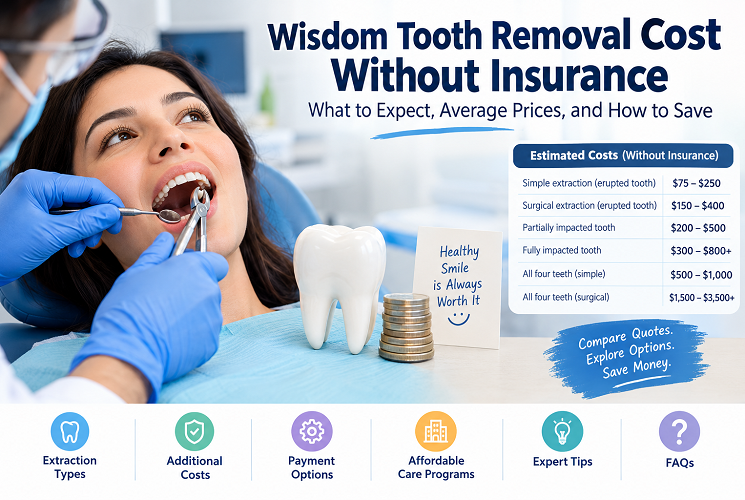
Here are some general estimates to help you plan your budget.
| Type of procedure | Estimated cost without insurance |
|---|---|
| Simple extraction of an erupted tooth | $75–$250 per tooth |
| Surgical extraction of an erupted tooth | $150–$400 per tooth |
| Removal of a partially impacted tooth | $200–$500 per tooth |
| Removal of a fully bony impacted tooth | $300–$800+ per tooth |
| All four wisdom teeth, simple extractions | $500–$1,000 |
| All four wisdom teeth, surgical removal | $1,500–$3,500+ |
These ranges are intended for initial budgeting. They are not standardised fees, and the final bill may be higher when anaesthesia, imaging, or other services cost extra.
For another pricing reference, Delta Dental has published estimates of approximately $720 for nonsurgical removal of all four wisdom teeth and $3,120 for surgical removal of four teeth below the gumline, including up to an hour of general anaesthesia. These figures reflect its published out-of-network cost guidance, not a guaranteed cash price for uninsured patients.
Why does the same procedure cost different amounts?
A fully erupted wisdom tooth is usually easier to remove because the dentist can access it directly. The procedure may require little more than loosening and extracting the tooth.
An impacted wisdom tooth presents a different challenge. The dentist or oral surgeon may need to make an incision, remove some bone, or divide the tooth into smaller pieces before extraction.
That extra work increases treatment time and can raise the overall cost. Your dentist will generally need to examine your mouth and review appropriate dental imaging before providing a reliable estimate.
What Determines the Cost of Wisdom Tooth Removal?
Several factors influence your final bill. Knowing what they are makes it easier to compare treatment options and understand why one quote may differ significantly from another.
1. The complexity of the extraction
The position of the tooth is one of the most important cost factors.
A fully erupted tooth may require a routine extraction. A partially impacted tooth can require a small surgical incision, while a deeply impacted tooth may need more extensive work.
The closer a tooth sits to important nerves or other structures, the more carefully the surgeon may need to plan the procedure. This can affect both the complexity and the price.
2. The number of teeth being removed
Removing one wisdom tooth generally costs less upfront than removing all four. However, some practices offer bundled pricing when several teeth are removed during the same appointment.
Ask for the price per tooth and the total cost for your recommended treatment plan. A combined appointment may reduce duplicated fees, but anaesthesia and surgical charges can still make the total substantial.
3. Anaesthesia and sedation
Local anaesthesia numbs the treatment area while you remain awake. Many practices include it in their extraction fee.
Other patients may need or prefer additional sedation, depending on the procedure, their anxiety level, and their medical history.
Common options include:
- Nitrous oxide: Helps you relax while remaining conscious.
- Oral sedation: Uses prescribed medication to reduce anxiety.
- IV sedation: Provides a deeper level of sedation under appropriate monitoring.
- General anaesthesia: Makes you unconscious during the procedure.
These options can carry separate fees. Ask whether your quote includes the medication, monitoring, anaesthesia provider, and recovery time.
Your dentist or oral surgeon should explain the benefits and risks of each appropriate option before you decide.
4. The provider you choose
General dentists often perform straightforward wisdom tooth extractions. Oral surgeons typically handle more complicated cases, including deeply impacted teeth.
A specialist may charge more, but the lowest price should not be your only consideration. Look at the provider’s qualifications, experience, treatment recommendations, and the services included in the quote.
If you receive very different recommendations from two providers, ask them to explain the reason for the difference. For complex cases, a second opinion may help you understand your options.
5. Your location and appointment type
Dental fees vary across the United States. Practices in expensive metropolitan areas may charge more than clinics in smaller communities.
Emergency appointments can also cost more than planned procedures. If your symptoms are manageable and your dentist confirms that treatment can safely wait, comparing providers ahead of time may help you save money.
However, do not postpone urgent treatment simply to find a lower price.
Additional Expenses to Include in Your Budget: Wisdom Tooth Removal Cost Without Insurance
The extraction fee may not cover everything. Consultation appointments, X-rays, sedation, medication, and follow-up visits can increase your total.
Use these figures as general planning estimates.
| Additional service | Estimated cost |
|---|---|
| Initial examination or consultation | $50–$150 |
| Dental X-rays or panoramic imaging | $50–$200 |
| Nitrous oxide sedation | $40–$150 |
| IV sedation or general anaesthesia | $250–$800+ |
| Prescription medication | $10–$60+ |
| Follow-up appointment | $0–$150 |
These amounts vary by provider and may overlap with bundled fees. Some offices include the consultation and imaging in their surgical package. Others charge for each service separately.
Before scheduling, request an itemised estimate covering:
- Examination and imaging fees
- The extraction fee for each tooth
- Anaesthesia and sedation charges
- Medication and follow-up appointments
- Potential additional costs if the procedure becomes more complicated
This makes comparisons more meaningful. A low advertised extraction price may not represent the amount you’ll actually pay.
Example: Calculating Your Total Wisdom Tooth Removal Cost
Consider a patient who needs two partially impacted wisdom teeth removed. The dental office quotes $350 per tooth for surgery, with separate fees for imaging and sedation.
The estimated bill might look like this:
| Expense | Example cost |
|---|---|
| Two surgical extractions | $700 |
| Consultation and X-rays | $125 |
| IV sedation | $400 |
| Medication | $30 |
| Estimated total | $1,255 |
This example illustrates how additional services can affect your budget. It is not a quote from an actual dental practice.
Now imagine that another patient needs four fully erupted wisdom teeth removed. A provider offers a $720 package with local anaesthesia included. The total may be considerably lower because the extractions require less surgical work.
Delta Dental’s published out-of-network pricing provides a similar reference point for four nonsurgical extractions. However, your local cash-pay price may differ.
The takeaway: Compare complete treatment estimates, not just the advertised price per tooth.
How to Get Wisdom Tooth Removal Without Insurance for Less
Paying out of pocket doesn’t mean you must accept the first price you receive. Several options may help you find appropriate treatment within your budget.
1. Compare at least three dental providers.
Contact general dentists and oral surgeons in your area. Explain that you’re paying without insurance and ask for their cash-pay price.
Give each office the same information about your treatment needs. Request an estimate that includes the procedure, imaging, and any recommended sedation.
Comparing three quotes can reveal meaningful differences in pricing and help you identify hidden fees.
2. Look into dental school clinics.
Dental schools often provide treatment at reduced rates. Students perform procedures under the supervision of licensed dental professionals, and some schools offer treatment through postgraduate residency programmes.
Appointments may take longer than they would at a private practice. Availability also varies by school and procedure.
Still, a dental school can be a valuable option if private treatment is outside your budget. Contact the clinic to confirm that it performs wisdom tooth extractions and ask what the treatment includes.
The American Dental Education Association provides resources for finding dental schools and learning about their clinics.
3. Contact community health centres.
Some community health centres offer dental care at reduced prices. Depending on the facility and your household income, you may qualify for a sliding-scale fee.
Start with the HRSA Find a Health Center tool. Search for nearby facilities and ask whether they provide wisdom tooth extractions for uninsured patients.
Not every center offers oral surgery, so confirm the available services before making an appointment.
4. Ask about cash discounts and payment plans
Some dental offices offer discounts to patients who pay directly. Others provide in-house payment arrangements or work with third-party financing companies.
Before agreeing to a payment plan, check the interest rate, fees, repayment period, and consequences of missed payments.
A low monthly payment may look manageable while still costing considerably more over time. Make sure you understand the total repayment amount.
5. Compare dental discount plans
Dental discount plans may provide lower fees through participating providers. Unlike insurance, they generally require a membership fee and offer negotiated prices rather than reimbursing claims.
Before enrolling, check whether oral surgeons in your area participate and whether the plan covers the specific procedure you need at a discounted rate.
Compare the membership cost and final treatment price with a direct cash quote. A discount plan is useful only if it saves you money overall.
Pros and Cons of Paying Without Dental Insurance: Wisdom Tooth Removal Cost Without Insurance
Paying directly for wisdom tooth removal has some advantages, but it also creates financial risks.
| Pros | Cons |
|---|---|
| No insurance claims to file | You pay the full bill yourself |
| Some practices offer cash discounts | Complex surgery can be expensive |
| Greater flexibility when comparing providers | Sedation may involve additional fees |
| No dental insurance annual maximum to manage | Unexpected treatment can increase costs |
| You can compare providers based on price and qualifications | Large bills may require financing |
One point deserves attention: uninsured patients do not always pay more than insured patients. A discounted cash price can sometimes be competitive with an insurance-negotiated rate.
However, the result depends on the provider and treatment. Always compare the actual amounts you would owe rather than assuming that insurance or a cash discount automatically offers the better deal.
Expert Tips Before Scheduling Your Procedure
A little preparation can help you avoid unnecessary expenses and make a better decision about your care.
- Get a written estimate. Ask for a complete breakdown of extraction, imaging, anesthesia, and follow-up charges.
- Confirm the procedure type. Find out whether each tooth requires a simple or surgical extraction.
- Ask why each tooth needs removal. Your dentist should explain the clinical reasons for recommending treatment.
- Check the provider’s qualifications. Make sure the dentist or oral surgeon has appropriate training and experience.
- Explore assistance programs. Ask about reduced fees, payment plans, and referrals to lower-cost clinics.
- Understand anesthesia requirements. If sedation is planned, ask about preparation, transportation, monitoring, and recovery.
- Get aftercare instructions. Know what to expect after surgery, which symptoms require attention, and when follow-up care is needed.
Should You Remove All Four Wisdom Teeth at Once?
Not everyone needs all four wisdom teeth removed. Some people have healthy teeth that remain problem-free, while others develop decay, recurring gum inflammation, infection, or damage to neighboring teeth.
Your dentist should evaluate each tooth individually and explain the reasons for recommending removal.
Removing multiple teeth during one appointment may reduce duplicated fees. However, it is not automatically the right choice for every patient.
Discuss the potential benefits, risks, alternatives, and total cost before deciding on a treatment plan.
When Should You Seek Dental Care?
Wisdom tooth discomfort does not always mean you need immediate surgery. Nevertheless, persistent pain, swollen gums, recurring inflammation, or food trapped around a tooth deserve a dental examination.
Seek urgent dental care if you develop worsening facial swelling, fever, or other signs of a spreading infection. Difficulty breathing or swallowing requires emergency medical attention.
Cost concerns should not prevent you from getting an assessment. A dentist can determine whether you need treatment immediately or whether you have time to explore affordable options.
If private treatment is unaffordable, contact a community health center or dental school. You can also use HRSA’s online tool to locate health centers that may provide lower-cost dental services.
(FAQs): About Wisdom Tooth Removal Cost Without Insurance
1. How much does wisdom tooth removal cost without insurance?
A simple extraction may cost around $75–$250 per tooth. Surgical removal of an impacted tooth may range from $200 to $800 or more. Removing all four wisdom teeth can cost several hundred to several thousand dollars, depending on complexity and anesthesia.
These are general estimates, not guaranteed prices. Request a written quote from your dental provider for a more accurate figure.
2. How much does it cost to remove all four wisdom teeth without insurance?
Four simple extractions may cost approximately $500–$1,000. Four surgical extractions may cost around $1,500–$3,500 or more, especially when sedation is involved.
Deeply impacted teeth, specialist fees, and anesthesia requirements can increase the total. Ask whether your provider offers a package price for all four teeth.
3. Can I get wisdom teeth removed for free?
Free treatment may be available through certain charitable dental programs, community events, or assistance initiatives. However, free wisdom tooth surgery is not guaranteed, and eligibility rules vary.
Contact dental schools, community health centers, and nonprofit dental organizations to ask about available programs. Explain your financial situation and whether your extraction is urgent.
4. Is wisdom tooth removal cheaper at a dental school?
Dental schools often offer reduced fees compared with private practices. Students work under professional supervision, although appointments may take longer.
Call the clinic to confirm that it performs your specific procedure. Ask about eligibility, waiting times, anesthesia charges, and whether follow-up visits are included.
5. Does the price include anesthesia?
Not always. Local anesthesia is often included in the extraction fee, but IV sedation and general anesthesia may cost extra.
Some practices bundle anesthesia into a package, while others bill it separately. Request an itemized estimate so you know what the quoted price covers.
6. Can I pay for wisdom tooth removal in monthly installments?
Some practices offer in-house payment plans or third-party financing. Terms vary, and approval may depend on the financing provider’s requirements.
Review the interest rate, fees, promotional conditions, and total repayment amount before signing an agreement. If you cannot afford the proposed payments, ask about lower-cost providers or assistance programs.
7. Is it cheaper to remove one wisdom tooth at a time?
Removing one tooth at a time may reduce the amount you pay at a single appointment. However, multiple visits can mean repeated consultation, imaging, or facility fees.
Ask your dentist to compare the total cost of staged treatment with removing multiple teeth during one session. The decision should also account for your health, recovery, and the clinical needs of each tooth.
8. Can I wait to remove a wisdom tooth until I can afford it?
Sometimes. A dentist may recommend monitoring a healthy wisdom tooth that is not causing problems. However, delaying treatment can be risky if the tooth has an infection, decay, or is damaging a neighboring tooth.
Ask your dentist how urgently you need treatment. If pain worsens or swelling develops, seek prompt evaluation instead of postponing care because of cost.
9. Does Medicaid cover wisdom tooth removal?
Medicaid dental benefits vary by state, eligibility group, and the type of treatment. Some programs cover medically necessary extractions, while others impose coverage limits.
Contact your state Medicaid agency or a participating dental provider to confirm your benefits. If you qualify, ask whether prior authorization is required before surgery.
10. How can I find the cheapest wisdom tooth removal near me?
Start by requesting written cash-pay estimates from several dental offices. Then compare dental school clinics, community health centers, and oral surgery practices.
Make sure each quote covers the same services, including imaging and anesthesia when needed. The lowest advertised price may exclude additional charges, so focus on the final estimated bill and the provider’s qualifications.
Conclusion: Wisdom Tooth Removal Cost Without Insurance
The wisdom tooth removal cost without insurance can range from a relatively affordable routine extraction to several thousand dollars for complex surgery involving multiple teeth. The final price depends on the tooth’s position, the number of teeth removed, anesthesia, and local dental fees.
Fortunately, you have ways to manage the expense. Compare cash-pay quotes, ask about payment plans, and explore dental schools or community health centers before committing to treatment.
Most importantly, balance affordability with appropriate care. Get a written estimate, understand why your dentist recommends the procedure, and ask how quickly you need treatment.
With a clear treatment plan and a little research, you can make a confident decision about your dental health without letting an unexpected bill catch you off guard.