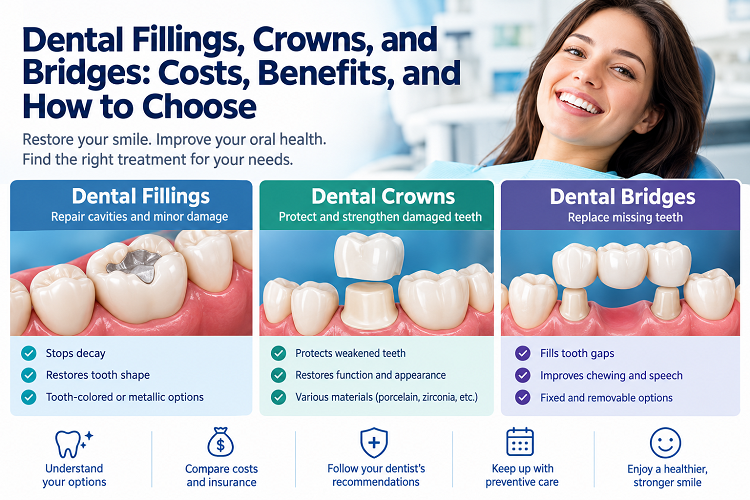

A damaged or missing tooth can affect more than your smile. It may make chewing uncomfortable, change your bite, or leave you hesitant to show your teeth. The good news is that modern dentistry offers several ways to restore damaged teeth and replace missing ones. Dental fillings crowns bridges are three common restorative treatments, but they serve different purposes. A filling repairs a cavity or small area of damage. A crown covers and protects a weakened tooth. A bridge replaces one or more missing teeth by connecting an artificial tooth to supporting teeth or dental implants.
Choosing between these options depends on the condition of your teeth, your oral health, your budget, and your long-term needs. A small cavity may need only a filling, while a badly damaged tooth could require a crown. If you’ve lost a tooth, a bridge may restore your smile and chewing ability.
This guide explains how dental fillings, crowns, and bridges work, what they typically cost in the United States, and how to care for them. You’ll also learn what to ask your dentist before choosing a treatment.
Also Read: Messed Up Teeth
What Are Dental Fillings, Crowns, and Bridges?
Although all three treatments restore oral function, each addresses a different dental problem.
- Dental fillings: Repair cavities and minor tooth damage by replacing the affected portion with restorative material.
- Dental crowns: Cover weakened or damaged teeth to restore their shape, strength, and function.
- Dental bridges: Replace missing teeth with artificial teeth supported by natural teeth, dental implants, or other appropriate structures.
Sometimes, a dentist recommends more than one treatment. For example, a severely decayed tooth might need root canal treatment followed by a crown. A traditional bridge may also use crowns on the teeth that support it.
The goal is to restore comfortable chewing, preserve healthy tooth structure when possible, and reduce the risk of further damage.
1. Dental Fillings: Repairing Cavities and Minor Damage
Dental fillings are among the most common restorative treatments. Dentists use them to repair cavities, small fractures, and localised tooth wear.
When bacteria and acids damage tooth enamel, a cavity can develop. The dentist removes the decayed tissue and fills the resulting space to restore the tooth’s shape and function.
Types of Dental Fillings
The best filling material depends on the cavity’s size, the tooth’s location, your cosmetic preferences, and your dentist’s clinical judgement.
Composite Resin Fillings
Composite fillings use tooth-coloured resin that blends with natural enamel. Dentists commonly recommend them for visible teeth and many small or medium-sized cavities.
The dentist bonds the material to the prepared tooth, then shapes it to fit your bite. Composite fillings look natural, although they may stain, wear down, or require replacement over time.
Amalgam Fillings
Dental amalgam contains a mixture of metals, including silver, tin, copper, and mercury. Dentists have used it for decades, particularly in back teeth that withstand substantial chewing pressure.
Amalgam is durable and can be a cost-conscious option. Its metallic appearance, however, makes it more noticeable than tooth-coloured alternatives.
Ceramic and Gold Restorations
Ceramic inlays and onlays can repair larger areas of damage when a conventional filling may not provide enough support. Gold alloys also offer durability in selected cases.
These restorations generally cost more than basic fillings and may require additional appointments or laboratory work.
When Do You Need a Filling?
Your dentist may recommend a filling if you have:
- A cavity caused by tooth decay.
- A small chip or fracture.
- Localised wear that requires restoration.
- A damaged or failing existing filling.
Not every early cavity requires a filling. When decay remains at an early stage, fluoride treatment and improved oral hygiene may help reverse the damage. Your dentist can determine whether the affected area needs restorative treatment.
Pros and Cons of Dental Fillings
Pros
- Usually cost less than crowns.
- Preserve more natural tooth structure.
- Often require just one appointment.
- Tooth-coloured materials provide a natural appearance.
Cons
- May not adequately support a severely weakened tooth.
- Can crack, wear down, or loosen.
- Large fillings may leave a tooth vulnerable to fractures.
- Some materials may stain or become noticeable.
A filling works best when enough healthy tooth structure remains to support it. For extensive damage, a crown or another indirect restoration may provide better protection.
2. Dental Crowns: Protecting Weak or Damaged Teeth
A dental crown is a custom-made cap that covers the visible portion of a tooth. It restores the tooth’s shape and helps it withstand everyday chewing forces.
Dentists often recommend crowns for teeth with extensive decay, large existing fillings, significant fractures, or damage following root canal treatment. Crowns can also cover dental implants or serve as supporting restorations for bridges.
Types of Dental Crowns
The right crown material depends on the tooth’s location, bite pressure, cosmetic goals, and budget.
- Porcelain and ceramic crowns: These materials closely resemble natural teeth. They work well for front teeth and many back teeth, depending on the specific material.
- Zirconia crowns: Made from strong dental ceramic, zirconia crowns can withstand substantial chewing forces. Dentists use them for both front and back teeth.
- Porcelain-fused-to-metal crowns: These combine a metal foundation with a porcelain exterior. They offer strength and a tooth-like appearance, although the porcelain can chip.
- Metal crowns: Gold alloys and other dental metals can provide excellent durability. Their metallic colour makes them less popular for visible teeth.
No single material suits every situation. Your dentist can explain which options offer the best balance of strength, appearance, and cost for your tooth.
What Happens During Crown Placement?
Traditional crown treatment usually takes two appointments, although some dental offices offer same-day crowns.
During the first visit, the dentist examines your tooth, removes decay when necessary, and reshapes the tooth to accommodate the crown. The dentist then takes a digital scan or impression.
If a dental laboratory must manufacture the crown, you’ll typically wear a temporary crown while waiting. At the second appointment, the dentist checks the permanent crown’s fit and bite before securing it in place.
Pros and Cons of Dental Crowns
Pros
- Protect weakened teeth from further damage.
- Restore chewing function and tooth shape.
- Improve the appearance of damaged teeth.
- Help preserve natural teeth that might otherwise require extraction.
Cons
- Usually cost more than conventional fillings.
- Require removal of some natural tooth structure.
- May cause temporary sensitivity after placement.
- Can chip, loosen, or develop decay underneath.
Crowns are durable, but they’re not indestructible. Teeth grinding, biting hard objects, and poor oral hygiene can shorten their lifespan.
3. Dental Bridges: Replacing Missing Teeth
A dental bridge fills a gap left by one or more missing teeth. It uses artificial teeth, called pontics, supported by natural teeth or dental implants.
Missing teeth can affect chewing, speech, and the alignment of surrounding teeth. A bridge restores the gap and can help improve bite function and appearance.
Dentists often recommend bridges when neighbouring teeth can provide reliable support and a patient wants a fixed replacement rather than a removable denture.
Types of Dental Bridges
Traditional Dental Bridge
A traditional bridge uses crowns placed on supporting teeth on both sides of the gap. Artificial teeth connect those crowns to fill the missing space.
This design is common when the neighbouring teeth can safely support the restoration. However, preparing those teeth requires removing some enamel, even if they are otherwise healthy.
Cantilever Bridge
A cantilever bridge attaches to a supporting tooth on only one side of the gap. Because the artificial tooth lacks support on the other side, dentists use this design selectively.
Its suitability depends on the missing tooth’s location, the patient’s bite, and the forces the restoration will experience.
Maryland Bridge
A Maryland bridge uses a metal or ceramic framework with wings bonded to the backs of neighboring teeth. It generally requires less removal of healthy tooth structure than a traditional bridge.
Dentists often consider this option for selected front-tooth replacements. However, the bonding can fail, and the design may not withstand heavy chewing forces.
Implant-Supported Bridge
An implant-supported bridge attaches to dental implants instead of relying entirely on natural teeth. It can be useful when several neighbouring teeth are missing.
Implant treatment involves surgery, sufficient bone support, and time for healing. Not everyone qualifies, and the total cost may exceed that of a conventional bridge.
What Is the Dental Bridge Procedure Like?
The process depends on the type of bridge you need.
For a traditional bridge, the dentist prepares the supporting teeth and takes impressions or digital scans. A dental laboratory creates the custom restoration, and you may wear a temporary bridge while waiting.
At a later appointment, the dentist checks the bridge’s fit, appearance, and bite before securing it.
Implant-supported bridges require additional steps, including implant placement and healing. Your dentist will explain the expected timeline based on your oral health and treatment plan.
After placement, cleaning beneath the bridge becomes part of your daily routine. Floss threaders and interdental brushes can help remove plaque from areas that regular flossing may not easily reach.
Pros and Cons of Dental Bridges
Pros
- Replace missing teeth with a fixed restoration.
- Improve chewing and speech.
- Restore the appearance of your smile.
- May require less treatment time than implant-based alternatives.
Cons
- Traditional bridges may require permanent changes to healthy supporting teeth.
- Decay and gum disease can threaten the supporting teeth.
- Cleaning beneath the artificial tooth requires extra care.
- Bridges eventually wear out and may need replacement.
A bridge can be an effective solution, but your dentist should evaluate the supporting teeth, gums, and bite before recommending one.
Dental Fillings vs. Crowns vs. Bridges: Key Differences
The main difference comes down to the problem each treatment solves. Fillings repair damaged areas, crowns protect and restore teeth, and bridges replace missing teeth.
| Feature | Dental Fillings | Dental Crowns | Dental Bridges |
|---|---|---|---|
| Main purpose | Repair cavities and minor damage | Protect and restore damaged teeth | Replace missing teeth |
| Typical candidate | Person with a small or moderate cavity | Person with a weakened or extensively damaged tooth | Person missing one or more teeth |
| Tooth preparation | Removes decay and prepares the cavity | Reshapes the tooth for coverage | Depends on the bridge design |
| Appearance | Tooth-colored or metallic | Can closely match natural teeth | Designed to blend with surrounding teeth |
| Treatment time | Often one visit | One or two visits; sometimes same-day | Usually multiple visits for conventional bridges |
| Main limitation | May not support a severely weakened tooth | Requires removal of some tooth structure | Can place extra demands on supporting teeth |
An additional option is an inlay or onlay. These restorations can repair more extensive damage than a standard filling without covering the entire tooth like a full crown.
Your dentist can explain whether this middle-ground approach is suitable for your tooth.
How Much Do Dental Fillings, Crowns, and Bridges Cost in the U.S.?
Dental treatment costs vary by location, material, case complexity, and the provider’s fees. Your dental insurance plan can also affect the amount you pay.
The following figures are broad planning estimates, not verified national averages or guaranteed prices. Actual quotes may fall outside these ranges.
| Treatment | Illustrative U.S. Cost Range |
|---|---|
| Composite filling | $150–$400 per tooth |
| Amalgam filling | $100–$300 per tooth |
| Dental crown | $800–$2,000 per tooth |
| Traditional three-unit bridge | $2,000–$5,000 or more |
| Implant-supported bridge | $4,000–$15,000 or more |
These estimates may exclude examinations, X-rays, root canal treatment, extractions, bone grafting, temporary restorations, and other additional services.
What Affects the Total Cost?
Several factors influence the final bill.
- Material: Premium ceramic, zirconia, and certain metal restorations may cost more than basic alternatives.
- Location: Dental fees differ between metropolitan areas and smaller communities.
- Complexity: Extensive decay or infection may require treatment before restoration.
- Insurance: Your plan may cover different percentages of basic and major restorative procedures.
- Number of teeth: A multi-unit bridge generally costs more than a single crown.
- Laboratory and technology: Custom laboratory work and digital production can affect the total fee.
Does Dental Insurance Cover These Treatments?
Many dental insurance plans cover fillings, crowns, and bridges when they meet the plan’s requirements. However, coverage levels and restrictions vary.
Some plans classify fillings as basic care and crowns or bridges as major care. Your policy may include deductibles, annual maximums, waiting periods, or limitations on replacement restorations.
Before scheduling treatment, request a written treatment plan and an estimate of your expected insurance payment. Confirm the details directly with your insurer, since an estimate doesn’t guarantee final payment.
How Long Do Fillings, Crowns, and Bridges Last?
No dental restoration lasts forever. Its lifespan depends on the material, quality of placement, bite pressure, oral hygiene, and regular dental care.
| Restoration | General Lifespan |
|---|---|
| Dental fillings | Several years to 10 years or longer |
| Dental crowns | Often 5–15 years; some last much longer |
| Dental bridges | Often 5–15 years; some last longer |
These figures are general estimates, not expiration dates. Some restorations remain functional well beyond these periods, while others fail sooner because of recurrent decay, fractures, gum disease, or problems with fit.
The best way to extend the life of a restoration is to protect the natural tooth and surrounding gums.
Expert Tips for Choosing the Right Dental Treatment: Dental Fillings Crowns Bridges
Before agreeing to treatment, make sure you understand why your dentist recommends a particular restoration.
1. Ask Whether Your Tooth Can Be Saved
If a tooth has extensive damage, ask whether a filling, inlay, onlay, or crown could preserve it. Extraction may be necessary in some cases, but it shouldn’t be the automatic choice when a tooth remains restorable.
2. Compare Materials, Not Just Prices
The cheapest restoration isn’t always the most economical choice over time. Consider durability, appearance, repairability, and how much healthy tooth structure must be removed.
Ask your dentist to explain the benefits and limitations of each suitable material.
3. Request a Written Treatment Plan
Your estimate should identify the proposed procedure, material, additional treatments, and expected insurance contribution.
If a treatment seems expensive or the diagnosis is unclear, consider a second opinion before making a decision.
4. Discuss Teeth Grinding
Clenching and grinding place extra stress on fillings, crowns, and bridges. If you grind your teeth during sleep, ask whether a custom night guard could help protect your restorations.
5. Keep Up With Preventive Care
Brush twice daily with fluoride toothpaste, clean between your teeth every day, and attend regular dental checkups. Your dentist may recommend a different recall schedule based on your risk of decay and gum disease.
6. Don’t Ignore Pain or Sensitivity
Mild sensitivity may occur after restorative treatment, but persistent or worsening symptoms deserve attention. Pain when biting, swelling, a loose crown, or a damaged bridge can signal a problem that needs prompt evaluation.
Seek urgent dental care for severe pain or facial swelling. If swelling affects your breathing or swallowing, seek emergency medical care.
(FAQs): About Dental fillings crowns bridges
1. Are dental fillings, crowns, and bridges the same thing?
No. Fillings repair cavities and minor damage. Crowns cover and protect weakened teeth. Bridges replace missing teeth using supporting teeth or dental implants.
Your dentist will recommend a treatment based on the condition of your teeth and gums.
2. Is a crown better than a filling?
Neither treatment is universally better. A filling usually works well for a small or moderate cavity when enough healthy tooth structure remains.
A crown may provide better protection when a tooth is extensively damaged or weakened. Your dentist should recommend the least extensive treatment that can reliably restore the tooth.
3. Does getting a dental filling hurt?
Dentists typically use local anesthesia to keep you comfortable while treating a cavity. You may feel pressure or vibration during the procedure.
Temporary sensitivity can occur afterward. Contact your dentist if the pain becomes severe, worsens, or persists.
4. How many years do dental crowns last?
Many crowns last around 5–15 years, although some last considerably longer. Material, bite forces, oral hygiene, and the condition of the underlying tooth all influence longevity.
Regular checkups help your dentist identify cracks, loose margins, or decay before they cause more extensive problems.
5. Can a dental bridge replace several missing teeth?
Yes. Certain bridge designs can replace multiple missing teeth in a row. The appropriate design depends on the size of the gap, the supporting teeth, and your overall oral health.
An implant-supported bridge may also be an option when several neighboring teeth are missing.
6. Is a dental bridge better than a dental implant?
It depends on your circumstances. A bridge can restore missing teeth without implant surgery and may require less treatment time.
An implant can replace a tooth without relying on neighboring natural teeth for support. However, implants require surgery and sufficient bone support. Your dentist can compare the benefits, risks, costs, and maintenance requirements of both options.
7. Can you get a crown after a root canal?
Yes. Dentists often recommend a crown after root canal treatment, especially for back teeth that experience substantial chewing forces.
The need for a crown depends on how much healthy tooth structure remains, the tooth’s location, and its risk of fracture.
8. Does dental insurance pay for fillings, crowns, and bridges?
Many dental insurance plans provide some coverage for these procedures. However, coverage levels, annual limits, waiting periods, and exclusions vary.
Ask your insurer to confirm your benefits and request a pretreatment estimate before beginning expensive restorative work.
9. How should I clean dental crowns and bridges?
Brush twice daily with fluoride toothpaste and clean between your teeth every day. Pay attention to the gumline around crowns, where plaque can accumulate.
For bridges, use a floss threader or an appropriate interdental cleaner to clean beneath the artificial tooth. Regular professional cleanings also help protect the supporting teeth and gums.
10. When should I see a dentist about a damaged tooth?
Arrange a dental appointment if you notice a cavity, a cracked tooth, persistent sensitivity, pain while chewing, or a loose restoration.
Seek prompt care for swelling, severe pain, or signs of infection. Early treatment may prevent more extensive damage and help preserve healthy tooth structure.
Conclusion: Dental fillings crowns bridges
Dental fillings, crowns, and bridges each play a distinct role in restorative dentistry. Fillings repair smaller areas of damage, crowns protect weakened teeth, and bridges replace missing teeth to restore function and appearance.
The right choice depends on the extent of tooth damage, the health of your gums, your budget, and your long-term dental goals. Cost matters, but preserving healthy tooth structure and choosing an appropriate restoration are equally important.
Before making a decision, discuss your options with a qualified dentist. Ask about materials, expected lifespan, insurance coverage, and alternatives. With appropriate treatment and consistent care, you can protect your restorations and maintain a healthier smile for years to come.