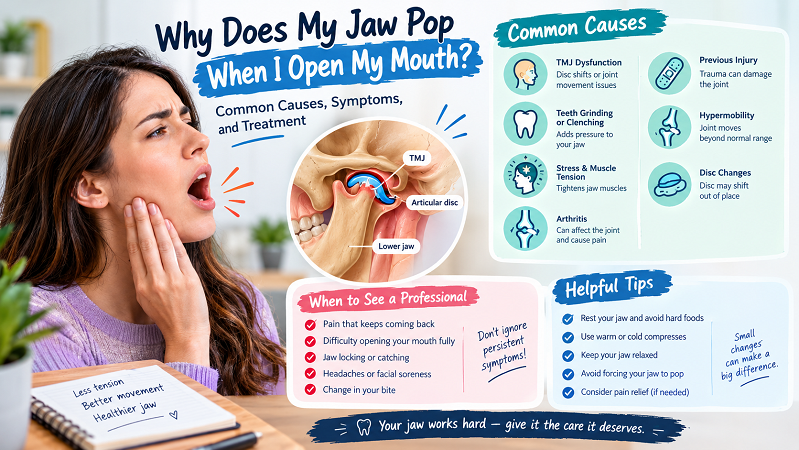

You open your mouth to yawn, take a bite of food, or brush your teeth. Suddenly, you hear a click or pop near your ear. Sometimes, it happens without pain. Other times, your jaw feels sore, stiff, or difficult to move. If you’ve wondered, “Why does my jaw pop when I open my mouth?” you’re not alone. This sound often involves the temporomandibular joint, or TMJ, which connects your lower jaw to your skull.
Several things can cause jaw popping. The joint’s cushioning disc may shift during movement, surrounding muscles may become tense, or the joint itself may develop a problem. Teeth grinding, jaw clenching, arthritis, and previous injuries can also contribute.
The good news is that painless jaw popping usually doesn’t require treatment when your jaw moves normally. However, clicking accompanied by pain, locking, or restricted movement deserves more attention.
Understanding what causes the sound can help you decide whether to monitor it at home or seek professional care. Here’s what you need to know about common causes, practical remedies, treatment options, and warning signs.
Also Read: Why Does My Jaw Pop
What Happens When Your Jaw Pops?
Your temporomandibular joints sit just in front of your ears, one on each side of your face. They allow you to open and close your mouth, chew food, speak, and yawn.
Each joint contains a small disc of cartilage-like tissue. This disc cushions the joint and helps the jaw move smoothly.
When you open your mouth, the lower jaw rotates and glides forward. If the disc shifts from its usual position and moves back during opening or closing, you may hear a clicking or popping sound. Other movements within the joint can produce similar noises.
Dentists and doctors use the term ‘temporomandibular disorders’ (TMD) for conditions affecting the jaw joints and the muscles responsible for jaw movement.
However, a clicking sound doesn’t automatically mean you have TMD. Some people experience painless jaw noises for years without developing other symptoms.
The most useful distinction is whether the sound comes with pain, stiffness, locking, or difficulty moving your mouth.
7 Common Reasons Your Jaw Pops When You Open Your Mouth: Why does my jaw pop when i open my mouth
Jaw popping has several possible causes. Although the sound can offer clues, it cannot establish a diagnosis on its own.
1. Temporomandibular Joint Dysfunction
Problems involving the temporomandibular joint are among the common explanations for jaw clicking.
The joint’s cushioning disc may move out of its usual position during opening and closing. When it shifts back, you might hear a distinct click. Some people experience this without discomfort, while others develop soreness or limited movement.
Other symptoms may include:
- Clicking near one or both ears.
- Popping when yawning or taking a large bite.
- Jaw tenderness after eating.
- A sensation that the jaw catches during movement.
- Discomfort when opening the mouth widely.
Painless clicking alone usually doesn’t require treatment. If the popping becomes painful or your jaw repeatedly locks, schedule an examination with a dentist or healthcare professional.
2. Teeth Grinding or Jaw Clenching
Do you wake up with a sore jaw or a headache near your temples? You may be grinding your teeth or clenching your jaw during sleep.
This habit, known as bruxism, places repeated pressure on the teeth, jaw muscles, and joints. Daytime clenching can have a similar effect, especially when you’re concentrating or dealing with stress.
Common signs include:
- Morning jaw soreness.
- Worn, chipped, or sensitive teeth.
- Tired facial muscles.
- Headaches around the temples.
- Increased discomfort after periods of clenching.
Grinding doesn’t necessarily mean you have a TMJ disorder. However, it can aggravate existing joint or muscle problems.
Try to keep your jaw relaxed during the day, avoid chewing gum, and ask your dentist whether you show signs of nighttime grinding. A professionally fitted night guard may protect your teeth when appropriate.
3. Stress and Muscle Tension
Stress can affect how you hold your jaw without you realising it.
Some people tighten their facial muscles when they feel anxious, frustrated, or focused on a demanding task. Over time, this tension may contribute to soreness around the cheeks, temples, and ears.
You might notice more discomfort after a stressful workday. You may also experience tension headaches or tenderness in the muscles used for chewing.
Stress isn’t the only explanation for jaw popping, but reducing muscle tension may help when clenching contributes to the problem.
Try relaxing your shoulders, breathing slowly, and allowing your upper and lower teeth to remain slightly apart when you’re not eating. These small adjustments can help you recognise and reduce unnecessary clenching.
4. Arthritis in the Jaw Joint
The TMJ can develop arthritis just like other joints in the body.
Osteoarthritis may gradually affect the joint’s cartilage and bone surfaces. Inflammatory forms of arthritis can also interfere with jaw movement.
Depending on the condition, you may experience:
- Grinding or crackling sounds.
- Pain while chewing.
- Stiffness, particularly after periods of inactivity.
- Reduced mouth opening.
- Tenderness around the affected joint.
Arthritis becomes a more relevant possibility when popping occurs alongside persistent pain or stiffness. However, clicking alone doesn’t confirm arthritis.
A dentist or physician can examine your jaw and determine whether imaging or further testing would help identify the cause.
5. A Previous Jaw Injury
A blow to the face, sports injury, accident, or other impact can damage the jaw joint and surrounding structures.
Symptoms may begin immediately or become more noticeable later. Depending on the injury, you might experience pain, swelling, bruising, clicking, or a change in how your teeth fit together.
If your jaw symptoms started after an injury, arrange a medical or dental assessment. Seek urgent care if you cannot open or close your mouth normally or suspect a fracture.
Don’t assume a new popping sound after an injury is harmless, particularly when your bite or ability to chew has changed.
6. Hypermobility or Excessive Joint Movement
Some people have joints that move farther than usual. This increased flexibility is called joint hypermobility.
When it affects the jaw, the joint may move excessively during wide opening. You might notice clicking, a slipping sensation, or difficulty returning the jaw to a comfortable position.
A large yawn can sometimes trigger these symptoms. However, frequent clicking doesn’t necessarily mean you have hypermobility.
Avoid repeatedly opening your mouth as wide as possible to test the joint. If your jaw frequently catches or feels unstable, consult a qualified healthcare professional.
7. Changes in the Joint’s Cushioning Disc
The small disc inside the TMJ helps the joint move smoothly. When the disc shifts from its normal position, jaw movement may produce clicking or popping.
Some disc displacements cause a noticeable click as the mouth opens and closes. Others may restrict movement or cause the jaw to lock.
This distinction matters because different joint conditions can produce similar sounds. A clinical examination helps determine whether the popping reflects a relatively harmless movement pattern or a problem that needs treatment.
A clicking jaw doesn’t automatically mean your disc is damaged. Imaging isn’t necessary in every case, and your clinician can decide whether further testing would change your care.
Is Jaw Popping Normal or a Sign of a Problem?
The sound itself isn’t always the best indicator of a problem. Pay attention to whether your jaw hurts, locks, or becomes difficult to move.
| Symptom | What it may indicate | Recommended action |
|---|---|---|
| Occasional painless clicking | Normal joint movement or disc movement | Monitor it if your jaw functions normally. |
| Clicking with jaw soreness | Possible TMD or muscle strain | Try gentle self-care and seek an evaluation if symptoms persist. |
| Popping with headaches or facial tension | Possible clenching or muscle-related TMD | Address clenching and discuss recurring symptoms with a clinician. |
| Grinding with stiffness | Possible joint changes, including arthritis | Arrange a dental or medical assessment. |
| Jaw catching or locking | A joint movement problem requiring evaluation | Seek prompt professional care. |
| Sudden symptoms after an injury | Possible joint or bone damage | Obtain urgent medical evaluation. |
These patterns offer general guidance, not a diagnosis. Several conditions can produce overlapping symptoms, so a professional examination may be necessary.
How to Stop: Why does my jaw pop when i open my mouth
If your jaw pops without pain or restricted movement, you may not need to do anything. The goal isn’t necessarily to eliminate every click. It’s to protect normal movement and address discomfort when it occurs.
If popping comes with soreness, a few conservative measures may help.
1. Give Your Jaw a Break
Temporarily reduce activities that require forceful or repeated chewing.
Consider avoiding:
- Chewing gum.
- Hard candy and ice.
- Tough meat and chewy foods.
- Large sandwiches that require a wide opening.
- Biting your fingernails or chewing on pen caps.
If chewing hurts, choose softer foods such as eggs, oatmeal, yoghurt, pasta, and soup. Return to your usual diet as your symptoms improve.
You don’t need to restrict your diet unnecessarily if chewing feels comfortable.
2. Apply a Warm or Cold Compress
Heat may help relax tense jaw muscles, while cold may ease discomfort after irritation or a recent injury.
Warm compress: Place a comfortably warm towel against the affected area for about 15–20 minutes. Avoid temperatures that could burn your skin.
Cold compress: Wrap an ice pack in a thin towel and apply it briefly. Never place ice directly against your skin.
Use whichever feels more comfortable. Stop if either method makes the pain worse.
3. Relax Your Jaw Throughout the Day
Your jaw muscles may remain tense even when you’re not eating or speaking.
Try this simple exercise:
- Sit comfortably and relax your shoulders.
- Let your lips rest together without forcing them closed.
- Keep your upper and lower teeth slightly apart.
- Breathe slowly and release tension in your cheeks.
- Repeat whenever you notice yourself clenching.
This encourages a relaxed resting position without forcing the joint into an unusual position.
4. Avoid Forcing Your Jaw to Pop
Repeatedly opening and closing your mouth to reproduce a click can aggravate sensitive tissues, especially when your jaw already hurts.
Don’t try to push the joint into place yourself. If your jaw locks open or closed, seek urgent professional care rather than forcing it.
5. Consider Over-the-Counter Pain Relief Carefully
Some people find short-term relief from over-the-counter medicines such as ibuprofen or acetaminophen. These medications may ease pain, but they don’t correct every underlying joint problem.
Follow the product label and check with a pharmacist or clinician if you have other medical conditions, take other medications, or aren’t sure which option is safe for you.
Ibuprofen and similar anti-inflammatory drugs aren’t suitable for everyone. If you need pain medicine repeatedly, arrange an assessment instead of relying on it indefinitely.
When Should You See a Dentist or Doctor?
Occasional painless clicking usually isn’t an emergency. However, persistent symptoms can interfere with eating, speaking, sleeping, and everyday activities.
Schedule an appointment with a dentist or healthcare professional if you experience:
- Jaw pain that keeps returning or doesn’t improve.
- Clicking that becomes painful or increasingly frequent.
- Difficulty opening your mouth fully.
- Repeated episodes of jaw locking or catching.
- Headaches or facial soreness associated with jaw movement.
- A sudden change in how your upper and lower teeth fit together.
A dentist can assess your teeth, jaw movement, and signs of grinding. Depending on the findings, you may need an oral and maxillofacial specialist, an orofacial pain specialist, or a physical therapist with relevant training.
Seek urgent medical care if your jaw suddenly becomes stuck open or closed, you cannot eat or drink because of the problem, or symptoms follow a significant injury. Severe swelling, fever, or difficulty swallowing also requires urgent assessment. Call emergency services for breathing difficulties.
Jaw pain can occasionally have causes unrelated to the joint. If it occurs with chest pressure, shortness of breath, sweating, or pain spreading to your arm, call 911 in the United States. These symptoms may indicate a heart attack.
How Do Doctors Diagnose Jaw Popping?
A clinician usually begins by reviewing your symptoms and examining your jaw. Mild cases don’t always require scans or extensive testing.
What to Expect During an Examination
Your dentist or doctor may ask:
- When did the popping begin?
- Does it happen on the left side, right side, or both?
- Does your jaw hurt when you chew or yawn?
- Has your jaw ever become stuck?
- Do you grind or clench your teeth?
- Have you recently experienced an injury?
The clinician may check your jaw’s range of motion, listen for joint sounds, and examine the muscles around your face and temples.
They may also inspect your teeth and bite for signs of grinding or other dental problems.
Will You Need an X-Ray or MRI?
Not necessarily. Imaging depends on your symptoms and examination findings.
- X-rays or CT scans: These may help evaluate fractures, bone damage, or certain joint changes.
- MRI: This can show soft tissues, including the cushioning disc inside the joint.
- No imaging: This may be appropriate when symptoms are mild and the examination doesn’t suggest a need for further testing.
Your clinician should recommend imaging when the results could clarify the diagnosis or change your treatment plan.
Treatment Options for Persistent Jaw Popping: Why does my jaw pop when i open my mouth
If your jaw continues to hurt or interferes with daily activities, a clinician may recommend treatment based on the underlying problem.
Conservative Self-Care
For many mild cases, treatment begins with simple changes. Soft foods, warm or cold compresses, reduced clenching, and avoiding painful movements may help symptoms settle.
These measures can reduce strain, although they won’t resolve every underlying joint condition.
Physical Therapy
A physical therapist with appropriate training may recommend gentle mobility exercises, manual techniques, or strategies to improve jaw function.
The right approach depends on your symptoms. Avoid forceful exercises that increase pain or repeatedly provoke clicking.
Dental Care and Night Guards
If grinding contributes to your symptoms, a dentist may recommend a properly fitted appliance to protect your teeth.
A night guard can help limit tooth damage, but its ability to relieve jaw pain varies. It also doesn’t reliably eliminate joint clicking.
Specialist Treatment
Persistent or complex symptoms may require evaluation by a specialist. Depending on the diagnosis, treatment could include additional therapies or selected procedures.
Most clinicians favor conservative, reversible options before considering invasive treatment. Injections and surgery aren’t routine solutions for painless clicking.
Be cautious about treatments that permanently reshape your teeth or change your bite solely to stop jaw popping. Such approaches lack good evidence for treating TMD and may cause harm.
Pros and Cons of Home Remedies for Jaw Popping: Why does my jaw pop when i open my mouth
Home care can be a useful starting point when symptoms are mild. However, it cannot replace an examination when warning signs appear.
| Approach | Potential benefits | Limitations |
|---|---|---|
| Soft foods | Reduce chewing strain | Don’t identify the underlying cause |
| Warm compress | May relax tense muscles | May not help every joint problem |
| Cold compress | May ease localized discomfort | Relief may be temporary |
| Relaxation techniques | May reduce clenching and muscle tension | Require consistent practice |
| Avoiding gum and hard foods | Reduces unnecessary jaw workload | May not eliminate harmless clicking |
| OTC pain relief | May temporarily ease pain | Has risks and doesn’t correct every cause |
The aim is to improve comfort and function, not to force every joint sound to disappear.
Expert Tips for Preventing Jaw Discomfort: Why does my jaw pop when i open my mouth
Small changes to everyday habits may reduce unnecessary strain on your jaw.
- Notice daytime clenching. Check your jaw during work, driving, gaming, or other focused activities.
- Avoid extreme mouth opening. Take care when yawning, and don’t force your mouth wider than feels comfortable.
- Choose manageable bites. Cut food into smaller pieces instead of stretching your mouth around large portions.
- Manage stress. Regular exercise, breathing exercises, and adequate sleep may help reduce muscle tension.
- Track your symptoms. Record when popping occurs, whether it hurts, and which activities trigger it.
- Address dental concerns. Tooth pain, damaged teeth, and signs of grinding may require separate treatment.
One particularly useful habit is to stop checking your jaw throughout the day. Constantly opening your mouth to reproduce a click can irritate the joint and make you more aware of normal sounds.
(FAQs): About why does my jaw pop when i open my mouth
1. Why does my jaw pop when I open my mouth but not hurt?
Painless popping often results from normal joint movement or a shift in the cushioning disc inside the TMJ. It usually doesn’t require treatment when your jaw moves normally. Seek an assessment if pain, locking, or restricted movement develops.
2. Is jaw popping a sign of TMJ disorder?
Not necessarily. TMJ refers to the joint itself, while TMD describes disorders affecting the joint and surrounding muscles. Clicking alone doesn’t establish a TMD diagnosis. Pain, stiffness, locking, and limited movement provide more useful clues.
3. Why does my jaw pop on one side?
One joint may move differently from the other, or its disc may shift during opening. Muscle tension and previous injuries can also contribute. If the popping is painful, persistent, or accompanied by locking, arrange a dental or medical evaluation.
4. Can stress cause my jaw to pop?
Stress may contribute to jaw clenching and muscle tension. These habits can aggravate jaw discomfort and existing joint symptoms. Relaxation techniques may help, but stress isn’t the only possible cause of popping.
5. Will my jaw popping go away on its own?
It may. Many mild jaw problems improve with time and conservative care. Painless clicking may also continue without causing harm. Persistent pain, worsening symptoms, or restricted movement deserves professional evaluation rather than indefinite waiting.
6. Should I stop eating if my jaw keeps popping?
Not usually. If you can chew comfortably, you generally don’t need to stop eating. If chewing hurts, choose soft foods and temporarily avoid tough or chewy items. Seek prompt care if you cannot eat or drink adequately.
7. Can I fix a popping jaw with exercises?
Gentle, professionally recommended exercises may improve movement and reduce muscle tension in selected cases. The right approach depends on the cause. Avoid forceful stretches or exercises designed to make your jaw repeatedly click. Stop any movement that increases pain.
8. Can a night guard stop my jaw from popping?
A night guard may protect your teeth from grinding and help some people manage related symptoms. However, it doesn’t reliably eliminate joint clicking. A dentist can determine whether an appliance suits your situation and monitor its effects.
9. When should I worry about a popping jaw?
Seek an evaluation when popping comes with pain, recurring headaches, difficulty opening your mouth, or repeated locking. Sudden locking, significant injury, or severe swelling requires urgent assessment. Call 911 for breathing difficulty or possible heart attack symptoms.
10. Does jaw popping mean I need surgery?
No. Surgery is rarely the first step for jaw popping, particularly when it doesn’t cause pain. Most treatment plans begin with conservative care. Specialists generally reserve invasive procedures for selected cases involving substantial dysfunction or structural damage after careful evaluation.
Conclusion: Why does my jaw pop when i open my mouth
If you’ve been wondering, “Why does my jaw pop when I open my mouth?” the explanation often involves movement within the temporomandibular joint or its surrounding tissues. Teeth grinding, muscle tension, arthritis, and previous injuries can also contribute.
Painless clicking is usually not a cause for concern when your jaw moves normally. You generally don’t need to treat the sound itself.
However, popping accompanied by pain, stiffness, locking, or difficulty chewing deserves attention. Consult a dentist or healthcare professional if these symptoms persist or interfere with everyday activities.
In the meantime, avoid forcing your jaw, reduce unnecessary chewing strain, and try gentle self-care when symptoms are mild.
The best approach is to pay attention to how your jaw feels and functions, not simply how loudly it clicks. A timely evaluation can identify treatable problems and help you avoid unnecessary treatments.



Pingback: Jaw Popping When Chewing: Causes and Treatment 2026