
Have you ever opened your mouth and heard a sudden pop or click from your jaw?
You may notice it while eating, yawning, talking, or brushing your teeth. Sometimes the sound happens once and disappears. In other cases, your jaw may pop repeatedly for weeks or months.
So, why does my jaw pop?
In many cases, a painless jaw pop is not a serious problem. The temporomandibular joints, or TMJs, can make clicking or popping sounds without causing pain or limiting movement. The National Institute of Dental and Craniofacial Research (NIDCR) notes that painless jaw sounds are common and generally do not require treatment.
However, jaw popping deserves more attention when it comes with pain, stiffness, locking, or difficulty opening your mouth.
This guide explains the most common reasons for jaw popping, what the sound can mean, and when professional dental care may be appropriate.
Why Does My Jaw Pop?
The most common explanation is movement within the temporomandibular joint.
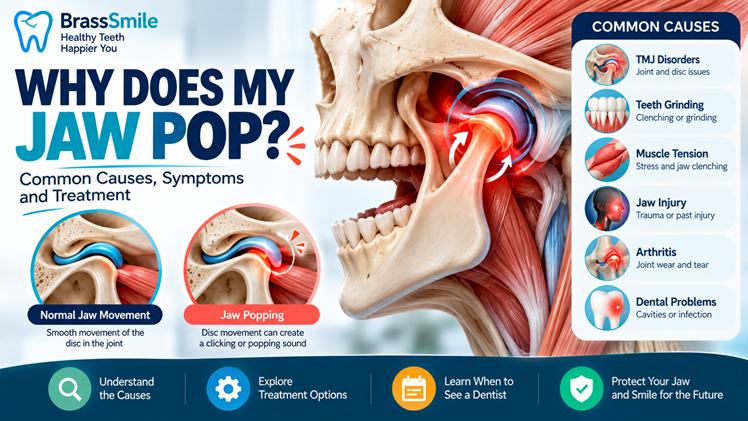
Your jaw has two TMJs. They sit on both sides of your face, just in front of your ears. These joints allow your lower jaw to move when you speak, chew, yawn, and open your mouth.
A small disc inside each joint helps the bones move smoothly. Changes in how the joint and surrounding tissues move can sometimes create a clicking or popping sound.
Importantly, jaw popping does not automatically mean you have a temporomandibular disorder (TMD).
NIDCR explains that clicking or popping without pain is common and usually does not require treatment. Painful clicking or popping, however, can be one symptom of TMD.
The difference between a harmless sound and a problem often depends on the symptoms that occur alongside it.
Is Jaw Popping Normal?
Yes, jaw popping can be normal when there is no pain or difficulty moving your jaw.
For example, you might hear a click when opening your mouth widely. If you can eat normally, speak comfortably, and open and close your mouth without pain, the sound alone may not indicate a disorder.
NIDCR specifically states that painless clicking and popping in the TMJs are common and considered normal. These sounds generally do not need treatment.
That does not mean every recurring jaw sound should be ignored.
Pay attention to changes.
A new popping sound accompanied by pain or restricted movement deserves evaluation by a dentist or healthcare professional.
Common Causes of Jaw Popping
Several factors can contribute to jaw popping. The exact cause is not always obvious.
1. Normal Movement of the Jaw Joint
Some people naturally have noticeable jaw sounds.
The joint can produce a click or pop as the jaw opens and closes. If there is no pain, swelling, stiffness, or limited movement, treatment may not be necessary.
This is one reason dentists do not treat every jaw sound.
2. Temporomandibular Disorders
TMD refers to a group of conditions involving the jaw joints and the muscles that control chewing.
NIDCR describes more than 30 conditions within the TMD category. These can affect the joints, chewing muscles, or both.
Possible TMD symptoms include:
- Jaw pain
- Facial pain
- Jaw stiffness
- Pain while chewing
- Limited jaw movement
- Jaw locking
- Painful clicking
- Painful popping
- Headaches associated with jaw problems
The important point is that jaw popping alone does not establish a TMD diagnosis.
3. Jaw Clenching or Teeth Grinding
Repeatedly clenching your jaw can place extra strain on the muscles and joints.
Some people clench their teeth during the day without realizing it. Others grind their teeth while sleeping.
These habits can contribute to jaw muscle discomfort and may occur alongside other jaw symptoms.
NIDCR recommends reducing habits such as jaw clenching and gum chewing when managing TMD-related discomfort.
4. Stress and Muscle Tension
Stress does not explain every case of jaw popping.
However, stress and other life factors may contribute to jaw muscle tension or clenching in some people.
NIDCR notes that psychological and life stressors, genetics, and how a person experiences pain may play a role in TMD development and persistence.
That means reducing unnecessary jaw tension can be useful when symptoms are present.
5. Previous Jaw Injury
A blow to the face or jaw can affect the temporomandibular joint.
Injury is one recognized potential contributor to some TMDs. However, many cases develop without a clear injury or single identifiable cause.
If your jaw began popping after an accident, fall, sports injury, or other trauma, tell your dentist or doctor.
Why Does My Jaw Keep Popping?
If you’re asking, “why does my jaw keep popping?”, the answer depends on what else you are experiencing.
Repeated popping without pain can still be harmless.
But frequent popping becomes more important when you also notice:
- Jaw pain
- Facial discomfort
- Ear-area pain
- Jaw stiffness
- Trouble opening your mouth
- Jaw locking
- Pain while chewing
- Changes in how your teeth fit together
- Increasing frequency or severity of symptoms
NIDCR identifies painful clicking or popping, stiffness, limited movement, and locking as symptoms that may signal TMD.
The sound itself is therefore less important than the overall pattern.
Why Is My Jaw Popping on One Side?
You may notice that only the left or right side of your jaw pops.
That can happen because the two TMJs do not always move in exactly the same way.
One side may produce a noticeable sound while the other remains quiet. A one-sided sound does not automatically mean that something is seriously wrong.
However, one-sided popping combined with pain, swelling, locking, or limited movement should be discussed with a dental professional.
A dentist can examine your jaw movement and determine whether further evaluation is appropriate.
Jaw Popping Without Pain: Should You Worry?
Usually, painless jaw popping is less concerning than painful jaw popping.
If your jaw pops but you can:
- Eat comfortably
- Open and close your mouth normally
- Speak without difficulty
- Move your jaw freely
- Avoid significant pain
there may be no need for treatment.
NIDCR states that painless TMJ clicking or popping is common and does not require treatment.
Still, monitor your symptoms.
If the popping changes or new symptoms develop, schedule a dental evaluation.
Jaw Popping With Pain Is Different
Pain changes the situation.
If your jaw pops and hurts when you chew, open your mouth, or move your jaw, a professional evaluation can help identify the cause.
Pain may involve the jaw joint or the muscles used for chewing. TMD is one possible explanation, but dental problems and other conditions can also cause pain around the jaw.
This is especially important if you have persistent or worsening symptoms.
If you also experience tooth pain, swelling, fever, or signs of infection, do not assume the problem is caused by TMD.
Jaw Clicking vs. Jaw Popping
People often use jaw clicking and jaw popping to describe similar sounds.
There can be subtle differences in how people describe the noises, but both can occur during jaw movement.
Searches such as:
- jaw clicking
- jaw popping
- why does my jaw pop
- why is my jaw popping
- why does my jaw keep popping
often describe the same basic concern: a noticeable sound from the jaw during movement.
The important clinical question is not simply what the sound is called.
Instead, consider whether you have pain, stiffness, locking, or limited movement.
When Should You See a Dentist for Jaw Popping?
Consider making a dental appointment if your jaw popping occurs with other symptoms.
Seek professional advice if you experience:
- Persistent jaw pain
- Pain when chewing
- Difficulty opening your mouth
- Jaw locking
- Increasing stiffness
- Painful clicking or popping
- Facial or neck pain associated with jaw movement
- A noticeable change in your bite
- Symptoms that interfere with eating or speaking
NIDCR lists jaw stiffness, limited movement, locking, and painful jaw sounds among symptoms that may indicate TMD.
You should also seek prompt medical attention after significant jaw trauma, especially if you cannot move your jaw normally.
How Is Jaw Popping Diagnosed?
There is no single test that identifies every TMD.
A dentist or doctor will usually begin by discussing your symptoms and medical history.
They may ask:
- When did the popping start?
- Does it happen every time you open your mouth?
- Is there pain?
- Does the pain spread to your face or neck?
- Does your jaw lock?
- Can you open your mouth normally?
- Do you clench or grind your teeth?
- Have you had a jaw injury?
The clinician may examine your jaw, face, and neck. They may also listen for clicking or popping and assess jaw movement.
In some situations, imaging such as an X-ray, MRI, or CT scan may be considered. NIDCR notes that imaging decisions depend on the individual clinical situation.
What Can You Do About Jaw Popping?
Treatment depends on the underlying problem.
If your jaw pops without pain or restricted movement, treatment may not be necessary.
When discomfort is present, conservative measures may be considered first.
Eat Softer Foods Temporarily
If chewing causes discomfort, softer foods can reduce the amount of work required from the jaw.
Avoid extremely hard or chewy foods while symptoms are active.
Reduce Excessive Jaw Movement
Try to avoid repeatedly opening your mouth as wide as possible.
This includes unnecessary wide yawning, excessive gum chewing, or deliberately making your jaw pop.
Stop Habitual Jaw Clenching
Pay attention to whether you regularly tighten your jaw.
Relaxing your jaw muscles when you are not eating or speaking may reduce unnecessary strain.
Use Heat or Cold When Appropriate
NIDCR lists heat or cold applied to the face, together with gentle exercises, among conservative approaches that may be recommended for some TMD symptoms.
Consider Over-the-Counter Pain Relief Carefully
Some people may benefit from short-term over-the-counter anti-inflammatory medicines.
However, these medications are not appropriate for everyone.
Follow the product directions and ask a healthcare professional or pharmacist if you are unsure whether a medication is safe for you.
What About a Night Guard?
A dentist may recommend an oral appliance in some situations.
These devices can protect teeth and may help address habits such as clenching.
However, they are not a universal solution for every jaw problem.
NIDCR notes that evidence about their effectiveness for TMD pain is limited. It also recommends caution with appliances designed to permanently change the bite.
If a dental appliance causes pain, contact your dentist.
Should You Try to Make Your Jaw Pop?
No.
If your jaw already clicks or pops, repeatedly forcing it to make the sound is not a useful treatment strategy.
Instead, let your jaw move naturally.
Avoid excessive gum chewing and other habits that repeatedly stress the jaw.
If popping is accompanied by pain or restricted movement, professional evaluation is more appropriate than trying to manipulate the joint yourself.
Can Jaw Popping Go Away on Its Own?
Yes, symptoms related to TMD can improve without treatment in many people.
NIDCR notes that many jaw joint and muscle problems are temporary. It also recommends starting with simple, conservative approaches when treatment is needed.
That does not mean every persistent symptom should be ignored.
The right approach depends on the severity, duration, and combination of symptoms.
Jaw Popping: Normal vs. Concerning
| Symptom | What It May Mean | What to Consider |
|---|---|---|
| Popping without pain | Often normal | Usually monitor |
| Occasional clicking | May occur with normal joint movement | Monitor for changes |
| Popping with pain | Possible jaw disorder or another problem | Dental evaluation |
| Popping with stiffness | Possible TMD symptom | Consider professional evaluation |
| Popping with locking | May indicate a joint problem | Seek dental or medical advice |
| Popping with limited movement | Possible TMD or other joint issue | Professional evaluation |
| Popping after trauma | Possible injury | Prompt assessment may be needed |
This table is a general guide, not a diagnosis. Several conditions can produce similar symptoms.
Common Myths About Jaw Popping
Myth 1: Every Jaw Pop Means TMJ Disorder
Not necessarily.
A painless pop or click can be common and may not require treatment.
Myth 2: Jaw Popping Always Gets Worse
There is no basis for assuming that every painless jaw sound will progress into a serious disorder.
Symptoms vary considerably between people.
Myth 3: You Need Your Bite Changed to Fix Jaw Popping
Current NIDCR guidance does not support the idea that changing the bite is a routine solution for TMD. Some irreversible bite-altering treatments lack sufficient evidence and may cause problems.
Myth 4: You Should Keep Stretching Until Your Jaw Clicks
More movement is not automatically better.
If exercises cause pain, stop and discuss them with a qualified professional.
How to Protect Your Jaw Every Day
Healthy jaw habits can be simple.
Try to:
- Avoid unnecessary gum chewing.
- Do not deliberately force your jaw to pop.
- Pay attention to jaw clenching.
- Avoid extremely hard foods when your jaw hurts.
- Maintain good dental hygiene.
- Treat dental problems promptly.
- Follow professional advice after jaw injuries.
- Notice changes in pain or jaw movement.
Your jaw performs thousands of movements every day.
Small habits can therefore matter when symptoms are already present.
Jaw Popping and Your Dental Health
Jaw problems can sometimes be confused with dental problems.
For example, pain while chewing may come from the jaw muscles or joint. But tooth decay, a cracked tooth, gum problems, or infection can also cause pain.
That is why identifying the exact source matters.
If you have both jaw popping and tooth pain, do not automatically assume that TMD is responsible.
A dental examination can help separate jaw-related symptoms from problems involving the teeth or gums.
For related information, see our guide on [Jaw Hurts When I Chew] and learn how different causes can produce pain during chewing.
Frequently Asked Questions
Why does my jaw pop when I open my mouth?
A jaw can pop because of movement within the temporomandibular joint. Painless clicking or popping is common and does not necessarily indicate TMD.
Why does my jaw keep popping?
Repeated popping can occur with normal jaw movement. It can also occur alongside TMD or other jaw problems. Pain, stiffness, locking, or limited movement are more important warning signs than the sound alone.
Why is my jaw popping but not hurting?
Painless jaw popping is common. According to NIDCR, painless clicking and popping in the TMJs generally do not require treatment.
Is jaw popping a sign of TMJ?
It can be one symptom of a temporomandibular disorder, particularly when popping is painful. However, painless popping alone does not establish a TMD diagnosis.
Should I worry if my jaw clicks?
An occasional painless click is often not a reason for concern. If clicking becomes painful or occurs with locking, stiffness, or limited movement, consider seeing a dentist.
Can stress cause jaw popping?
Stress may contribute to jaw clenching or muscle tension. NIDCR notes that psychological and life stressors may play a role in TMD development and persistence.
How can I stop my jaw from popping?
There is no single treatment for all jaw popping. If the sound is painless, treatment may not be necessary. If symptoms are painful or interfere with movement, a dentist or doctor can determine the cause.
Can jaw popping go away naturally?
Yes. Some TMD-related symptoms improve without treatment. Conservative care may also help when symptoms are present.
When should I see a dentist about jaw popping?
See a dentist if popping is painful, persistent with other symptoms, or accompanied by jaw locking, stiffness, limited movement, or difficulty chewing.
Is jaw popping the same as jaw clicking?
The terms are often used interchangeably by patients. Both describe sounds coming from the jaw during movement. The presence of pain and movement problems is more clinically important.
Final Thoughts
If you’re searching “why does my jaw pop,” the answer is not always a serious dental problem.
A painless click or pop can be common. It may simply occur as your temporomandibular joints move.
The situation deserves more attention when jaw popping comes with pain, stiffness, locking, or limited movement. Those symptoms can occur with TMD and should be evaluated by an appropriate healthcare professional.
Avoid trying to force your jaw to pop or aggressively manipulate the joint. If symptoms persist or interfere with everyday activities, professional evaluation can help identify the underlying cause.
Most importantly, focus on the complete picture rather than the sound alone.
Medical Disclaimer
This article is for general educational purposes only. It is not a substitute for professional dental or medical advice, diagnosis, or treatment. If you have significant jaw pain, swelling, trauma, difficulty opening your mouth, or other concerning symptoms, contact a qualified healthcare professional.